Tuesday, August 19, 2014

theatre review JESUS CHRIST SUPERSTAR, Desert Stages Theatre, August 15

Click here to read my review at Talkin' Broadway of Jesus Christ Superstar at Desert Stages Theatre.

 The Desert Stages Theatre limited run production of the rock operaJesus Christ Superstar does justice to this classic show, with a rocking cast and a smoking band. Loosely based on the final days of Jesus of Nazareth, this production features Sean Mullaney giving a soulful take in the title role. Originally announced to play in DST's smaller Actors Café theatre space, the production, fortunately, was moved to the larger Cullity Hall which serves the large cast and large band well. And even though this is a limited run, with just six performances over two weekends, it is a fairly fully staged production, with vibrant costumes, make-up and lighting plus enough choreography to warrant a full-fledged extended run. This production is recommended for anyone who is a fan of the show or rock music in general.

With music by Andrew Lloyd Webber and lyrics by Tim Rice, Jesus Christ Superstar started out as a 1970 concept recording before ending up on Broadway in 1971. A movie, numerous tours, and three Broadway revivals followed. With minimal dialogue, the sung-through show follows the Gospels' accounts of the last week in Jesus' life. The musical swiftly covers many events, including Jesus' entry into Jerusalem, Mary Magdalene's devotion to him, the last supper, his betrayal by Judas, his trial by Pontius Pilate, and the crucifixion.

Chelsey Louise and Sean Mullaney

The combination of Lloyd Webber's impressive and inspired rock music and Rice's lyrics that touch upon the personal conflicts and struggles that Jesus, Judas and Mary Magdalene encounter, catapulted the two songwriters to fame and a Tony nomination for Best Original Score. The show's best known tune is the chart topping hit "I Don't Know How to Love Him" but other songs, including "Superstar," "Everything's Alright" and "Gethsemane (I Only Want to Say)" are just as memorable.

While the majority of the conflict-ridden numbers revolve around Judas' change from devotion to his ultimate betrayal of Jesus, and Jesus' internal struggles, it's nice to see that Desert Stages is treating the show more as the rock opera that it was originally written as, instead of a traditional musical theatre piece like many other theatre companies try to turn it into. With a cast made up of singers with rock music voices, and a band conducted by the always noteworthy Mark 4man, the combination of blaring horns, funky guitar licks, and wailing rock falsettos give this production a full out sound that comes at you like no other show I've ever seen at DST.

With an almost eerie somberness and large doses of passion, humility and strength, Sean Mullaney demonstrates a nice intensity combined with a wide musical range in his portrayal of Jesus, with appropriate rocker squeals as well as nice elements of sadness and agony. The amount of anguish and questioning in his forcefully sung "Gethsemane" perfectly shows how Jesus questions his mission even when he clearly knows he is about to be betrayed and ultimately die. Mullaney's expressions show Jesus' flaws, his conflicted nature, and the uncertainty of his actions. It is an expertly delivered and sung performance.

Josh Kontak
With a brooding presence and an antsiness that shows off his dissatisfaction, Josh Kontak makes Judas a convincing tragic character, at first warning Jesus not to go too far, then questioning the influence of Mary Magdalene, and ultimately deciding that Jesus must be stopped. Kontak's voice easily manages the tricky range of Judas' songs, and his looks and mannerisms echo the heavy, conflicted lyrics. Chelsey Louise gives Mary a soothing and loving touch, and her earthy, gutsy and gritty vocals give a brassiness to her songs. It isn't your usual delivery of Mary's numbers, but it works with the deep tones grounding the lyrics with a realism that sets Mary apart from the others and makes her more of an outsider than I've noticed in the numerous other productions of this show I've seen. Her delivery of "Can We Start Again Please?" is especially moving.

In a crisp suit and dark sunglasses, Matt Newhard makes an imposing Pilate. Yet, even beneath the dark shades we see the man who doesn't quite know what to do with this so-called King, even when the people are screaming for Jesus' execution. His aloofness only adds to his commanding presence, and the steely emotion he displays in the trial scene when Jesus is being whipped is disturbingly stunning. In the ensemble are a couple of hard working Phoenix actors, Devon Nickel and Rick Davis, who have appeared in numerous shows across the Valley this season. For this production they both play numerous characters, from priests to apostles, with ease. Also of note, Daniela Castro, who plays the woman who questions Peter about his relationship to Jesus, has a clear, distinctive voice and a notable stage presence.

The intimacy of the theatre allows the many emotional moments in this show to be especially moving. Stripped away of just about every pretense, with no elaborate sets to get in the way, the production lets the music, lyrics and story firmly take center stage. Directors Justin Heffner and Mullaney don't add any camp elements to the production and also keep the cast seated on one side of the stage throughout most of the show, which adds an effective "Greek Chorus" element to the proceedings. There is a nice combination of both a large amount of looseness and a sense of urgency in the staging that works well with the thrust of the show. No choreographer is mentioned, so I'm assuming Heffner and Mullaney provided the simple yet effective dance movement. Costume, hair and makeup designer Lindsey Brown includes a wide range of styles from flower child to heavy metal rocker and hippie, along with plenty of dark eyeliner, which ties in nicely with the tattoos, mohawks, ear and nose piercings that the cast members sport and gives the whole production a modern rock update. Chris Caracciolo's lighting design uses lush reds combined with evocative shadows to paint some creative scenes.

The band features some impressive playing, with particular note of Jason Davis, Dallas Fisher, Ben Foos, Heffner and Michael Brandt on trumpet, trombone, bass, and guitars, respectively, since those instruments are heavily featured in Lloyd Webber's orchestration. The 12-piece band might be smaller than some other productions of this musical, but under 4man's conducting as well as his and Heffner's musical direction, it is full, distinctive and very loud. Before the performance I attended the ushers even offered ear plugs, though they weren't necessary.

A few quibbles: the staging of a few key scenes, including Judas' death and the shuttling of Jesus from Pilate to Herod and back again aren't staged fully enough to clearly understand what is going on. The issue with these scenes, and a few others, can also be blamed somewhat on the lack of any substantial dialogue in the show. Also, for some reason, they've opted to cut the last few minutes of the show that includes the crucifixion scene, Jesus' last words on the cross, and the final musical moment with Mary and the apostles reflecting on Jesus' impact and importance on their lives, instead having the show end after "Superstar."

Still, even with these few shortcomings, Jesus Christ Superstar at Desert Stage Theatre is a moving production with a remarkable cast and an exceptional band.

The Desert Stages production of Jesus Christ Superstar runs through August 24th, 2014, with performances at 4720 N. Scottsdale Road in Scottsdale. Tickets are available at www.DesertStages.org or by phone at (480) 483-1664.

Photos: Wade Moran

theatre review WEST SIDE STORY, Valley Youth Theatre, August 10

Click here to read my review at Talkin' Broadway of the Valley Youth Theatre's excellent production of West Side Story.

Megan Farinella and Sedona Urias-Ramonett
If you were to make a list of quintessential American musicals, West Side Story would have to be toward the top of the list. With the perfect combination of drama, music and dance, and containing some of the most well-known theatre songs, West Side Story is a true classic with a message that still rings true more than fifty five years after it first premiered. The superb Valley Youth Theatre production of the show that opened this past weekend has an extremely gifted cast of high school and college aged actors. With almost every character in the show played by teenagers, the relevant age of the cast adds a realistic, poignant edge that you just don't get from productions that use actors in their 30s to portray these young, iconic characters. With excellent direction, outstanding creative elements and a sublime cast, this is a must see production.

Written by Arthur Laurents, with music by Leonard Bernstein, lyrics by Stephen Sondheim, and originally directed and choreographed by Jerome Robbins, West Side Story is a modern updating of Shakespeare'sRomeo and Juliet. Set in 1950s New York City, the musical changes Shakespeare's two feuding families into two rival gangs, one white, the Jets, and one Puerto Rican, the Sharks. With both gangs fighting for home turf, the star-crossed lovers, the former Jet Tony and Maria, sister of the Shark's leader Bernardo, get caught in the middle. With themes of loyalty, friendship and dedication to family and one's heritage, West Side Story is a moving piece of theatre, especially as it demonstrates how Tony and Maria's love helps them overcome their differences, despite all the feuding that is constantly surrounding them.

With ballads like "Somewhere" and "Something's Coming," the comical numbers "I Feel Pretty" and "Officer Krupke," the heavy dance sequences "Cool" and "America," and the lovely duets "A Boy Like That" and "Tonight," there isn't one bad song in the score. These songs are classics in the truest sense of the word. Each musical number adds to the character development and plot, and the dream ballet of "Somewhere" is perfectly placed at the height of the tension, adding beauty to the ugliness we've just experienced. Bernstein and Sondheim's music and lyrics perfectly complement each other, with each writer at the top of his game.

The cast for the Valley Youth Theatre production is simply top notch, all of them gifted actors as well as singers, and almost all of them able to deliver the abundant choreography with ease. Mike Sprenger as Tony has a clear and pure voice that serves his numerous ballads perfectly. His delivery of both "Something's Coming" and "Maria" are touching and genuine. Sedona Urias-Ramonett has the requisite young innocent looks as Maria, but she also naturally shows the yearning underneath. She has a soaring, lilting voice that is put to great use throughout the show. Sprenger and Urias-Ramonett's many scenes and songs together are tender and engaging with both actors extremely realistic in their portrayals of these two young lovers.

The feisty character of Anita, Bernardo's girlfriend, is almost always the highlight of this musical, and Megan Farinella is excellent in the part. She scored as "Rosie" in the recent Desert Stages Theatre production of Bye Bye Birdie and is even more effective here. She brings a raw, nuanced naturalness to her portrayal, with her gutsy, spirited delivery of "America" a major highlight of the production. Her acting is just as engaging and her voice easily delivers the complex Sondheim lyrics. Her duet of "A Boy Like That" with Urias-Ramonett is perfect.

In the supporting parts, Jonathan Ramirez as Bernardo and Michael Schulz as Riff are both effective in delivering the pent-up energy and anger required for the leaders of the two rival gangs. They are both gifted actors and singers and manage to dance the intricate steps with ease. Ramirez also brandishes a switchblade in the rumble scene with a heightened sense of agility. 

With an extremely large cast of over forty people, there are far too many people to mention, but Connor Baker's Action, Brandon Brown's Baby John and Noah Guzman's Chino are all unique and terrific in their portrayals. Also, Ally Lansdowne brings a nice level of spirit and distinctiveness to Anybodys, the girl who wants to be a member of the Jets. Her delivery of the opening part of "Somewhere" is especially touching. As the three adults in the cast, Peter Hart, Mitch Etter and Kevin Ohlfest as Doc, Lieutenant Schrank and Officer Krupke, don't let their years of experience overshadow their scenes with the younger cast members.

Director Bobb Cooper doesn't make a single misstep in getting his large cast to achieve the emotions and comical moments required in the dialogue and lyrics. He keeps the show moving at a fast clip but appropriately lets the emotional final scene play out at a slow enough pace to allow the scene be even more impactful. He also never makes the stage seem over crowded, which can't be easy with such a large cast, and constantly keeps his actors in motion. His direction of the rumble scene is complex, nerve racking and action packed.

Just about every member of the large cast is required to dance. Choreographers Katie Casey and Lucas Coatney must have spent many hours drilling their dancers in the nuances of Jerome Robbins' original iconic and intricate choreography. With just a few small exceptions, the cast is almost always in sync and the opening number and the "Dance at the Gym" sequence are red hot with a heightened sense of energy. This production's dream ballet of "Somewhere" is one of the most moving versions of this number I've ever seen.

While the scenery wasn't designed specifically for this production, rented instead from the Fullerton Civic Light Opera Music Theatre, it shows how renting sets and drops from a fellow professional theatre company can greatly enhance a production. With a series of large drops and set pieces, including garbage cans, scaffolding, large fence pieces and fire escapes, the scenic design successfully portrays the many locations in 1957 Manhattan. I really like the use of forced perspective on the drops that are effective in portraying various places, including the underside of the freeway during the rumble scene and a large New York street filled with apartment buildings, stores and billboards. Lighting by Mike Eddy is evocative with a lovely use of shadows, dark blues, purples and reds to paint the many scenes. Costumes by Karol Cooper provide a brilliant and varied color palette, with the dresses for the women, especially the bright red ones for Anita, a mix of fabrics and patterns. Sound design by Clearwing is extremely vibrant, with the large cast perfectly mic'd and not a single line of dialogue or lyric missed. Music director Mark Fearey does an excellent job conducting the twenty-two piece orchestra.

It's been a few years since I saw a production of West Side Story and seeing a top notch production like this one reminds me again how brilliant a show this is. Sure, maybe our young lovers fall in love a little too quickly and when one character dies their sibling doesn't seem to mourn them for too long. But those slightly unrealistic moments detract very little from the intelligent and thought provoking simple message of acceptance and tolerance at the core of Arthur Laurent's book. With one of the most moving and significant scores in musical theatre history, the message is timely and timeless. The young talented cast adding an additional layer of relevance, the Valley Youth Theatre production of West Side Story is extremely poignant and highly recommended.

The Valley Youth Theatre production of West Side Story runs through August 24th, 2014, at the Herberger Theater Center, 222 E. Monroe Street in Phoenix. Tickets can be purchased by calling 602-252-8497 or atwww.herbergertheater.org/calendar/west-side-story/. For information on VYT's upcoming season, visitwww.vyt.com.
Mike Sprenger and Sedona Urias-Ramonett
Photos: Barry Smith


Tuesday, August 5, 2014

cabaret review THAT'S LIFE, Actors Theatre, July 27

To read my review at Talkin' Broadway of the cabaret show That's Life, just click on this link.

As part of its Summer of Theatre series, Actors Theatre is presenting two performances of a wonderful cabaret show entitled That's Life: From Sinatra to Sondheim. Featuring vocalists Kristen Drathman and Rusty Ferracane, the show includes a wide range of songs that, as Drathman states, covers "our experiences in life, the highs, the lows, the good, the bad, the ugly." With superb accompaniment and arrangements by musical director Craig Bohmler, the show also excels with succinct patter full of personal anecdotes that relate to each song.

With numerous show stoppers, the 80-minute concert includes twenty songs, most of them revolving around the various phases of relationships. Drathman and Ferracane instill each song with warmth and honesty, which resonates with the lyrics; Bohmler's piano skills are exemplary and his arrangements rich and varied. With just one exception, the patter is short and specific, connects to the material and is well scripted, yet seems natural. Since it covers such a wide range of "life" topics, including long distance romances, learning to be yourself, divorce, and children, which are all experiences the audience is able to easily relate to, it makes the references, the song selections, and the show as a whole even more successful.

Drathman's excellent facial expressions and wide eyes bring added emotion to her songs. Her knock-out delivery of several numbers from musicals, including "Cabaret" Thoroughly Modern Millie's "Gimme Gimme" and "The Trolley Song" from Meet Me in St. Louis is equally matched by her quiet, grounded delivery of Martina McBride's pop and country smash "In My Daughter's Eyes." Her romantically lush "I'll Be Seeing You" is also very moving.

Ferracane is just as effective, filling his delivery of each song with a deep personal connection. While this is best shown in "I Am What I Am" from La Cage aux Folles, with his phrasing and passion he also provides an individual association with the numerous Sinatra songs in the evening, including a bluesy take on "One for My Baby (and One More for the Road)" and a rousing "New York, New York."

While the majority of the evening's performances are solos, there are also a few duets, including the opening number: an interesting take on the famous Judy Garland/Barbra Streisand pairing of "Happy Days are Here Again" and "Get Happy." It's interesting in that it is usually performed by two women, yet works just as effectively when sung by a woman and a man. Other duet highlights include a touching take on "My Funny Valentine" and an excellently arranged "I've Got Rhythm" that starts slow and then speeds up, includes an excellent piano solo in the middle, and ends with both Ferracane and Drathman belting to the rafters. Another highlight is their superb delivery of a slightly abridged version of the duet of "A Boy Like That" and "I Have a Love" from West Side Story, another song usually performed by two women. Having it sung by a woman and a man, with the man professing "I love him, I'm his, and everything he, is I am too," gives it a more modern sensibility.

Bohmler's expert playing and arrangements are excellent, complementing and never detracting from the vocals. He also has a couple of moments to shine, giving expert solo versions of Scott Joplin's "The Entertainer" and a stirring rendition of Chopin's "Étude for Aeolian Harp."

Just two quibbles. First, the show does mention both Sinatra and Sondheim in the title and while there were several songs Sinatra was famous for singing, there is only one Sondheim song featured in the evening. And that is a song from West Side Story, one for which he only wrote the lyrics, not the music. Second, Rusty's story about seeing the movie Ice Castles with his mother is humorous, but runs on a bit too long and the point of the story is a bit unclear.

However, those are two very small negative points in an otherwise enjoyable, moving and extremely entertaining concert. With a theme that anyone can relate to as well as a vast and varied song selection, That's Life: From Sinatra to Sondheim is a cabaret concert with two exceptional singers, an amazing pianist and many thrilling moments.

The final performance of the Actors Theatre production of That's Life: From Sinatra to Sondheim is on August 10th, 2014, at the Black Theatre Troupe/Helen K. Mason Performing Arts Center, at 1333 East Washington Street in downtown Phoenix. Ticket information can be found at actorstheatrephx.org/ or by calling (602) 888-0368.

cabaret review A Night with Noël: The Music of Noël Coward, Actors Theatre, July 26

Click here to read my review at Talkin' Broadway of the recent cabaret show A Night with Noël: The Music of Noël Coward.

Ian Christiansen
When you say the name Noël Coward images of men in tuxedos, ladies in evening gowns, gin martinis and witty repartee immediately come to mind. Coward wrote several well-known plays, but he was also a proficient composer, having written hundreds of songs. As part of its Summer of Theatre series, Actors Theatre presented a one night cabaret entitled A Night with Noël: The Music of Noël Coward on Saturday evening.

The basis of this cabaret came from one of the shows that Actors Theatre is presenting in repertory this summer, Sandy Rustin's farcical British set The Cottage. Rustin based her play somewhat on Coward's famous comedies, even including a brief reference to the character "Mrs. Worthington," the focus of one of Coward's most famous songs, in her play. Actors Theatre's Artistic Director Matthew Wiener approached actor and singer Ian Christiansen, who is appearing in both summer repertory plays, about creating an evening of Coward music as a way to complement The Cottage—and A Night with Noël was born.

Coward's plays are known for a combination of highbrow sophistication, use of double entendre and biting words, and his songs are no different. For this cabaret, the good news is that Christiansen featured most of Coward's famous songs, including "Mad Dogs and Englishmen," "A Room with a View" and "Mad About the Boy." Also, most of the songs were expertly performed, with Christiansen taking turns with Heather Fallon to deliver them, and both performers looked the typical height of Coward sophistication, with Christiansen in a crisp tuxedo and Fallon in a fetching black evening dress. The bad news is that Christiansen's off-the-cuff and unrehearsed patter, including, I believe, a couple of misstated facts, while very funny at times, was unorganized, lacked focus, and was just about as far as you can get from the sophistication that Coward was known for, so it was at odds with the musical moments. The patter didn't include any information about Coward that the average theatregoer wouldn't have already known: he wrote a few plays, wrote witty and biting songs, was knighted, was homosexual and worked with Elaine Stritch. The show also only included nine songs, with the odd decision to both open and close the show with two songs that Coward didn't write. For a show that ran an hour, better organized and researched patter that either gave us some new or rare information about Coward, or at least was focused or even somehow tied to Christiansen's personal experiences, would have made the show more effective, informative and also allowed room for a couple of additional Coward songs.

Fortunately, Coward's music received fairly refined performances, so taken just on the musical moments, the evening excelled. With just one small exception, Christiansen didn't have any problems with Porter's fast paced, tongue-tying lyrics for "Mad Dogs and Englishmen" and was wonderfully dry and witty in his delivery of the biting "(Don't Put Your Daughter on the Stage) Mrs. Worthington." Using a nice crisp English accent throughout his singing, Christiansen also showed a touching side in his sweet and soft take on the romantic ballad "I'll See You Again." The evening opened with Christiansen performing Flanders and Swann's "A Word on My Ear," a funny song about a tone deaf performer, and ended with a version of Cole Porter's "Let's Do It (Let's Fall in Love)" that included some funny updated lyrics that Christiansen wrote himself.
Heather Fallon shined in her take on the ballads "A Room with a View" and "He Never Did That to Me" and also showed her comic abilities on "I Went to a Marvellous Party." The comical "Party" was broken up into three segments and interspersed throughout the evening, which was a great decision and tied nicely into the proceedings since the song is a first person's descriptions of the events over the course of a long party. Fallon's hilarious delivery of the last piece was perfect, sung with a drunken aplomb. But it was Fallon's performance of "Mad About the Boy" that was the highlight of the night. Sung with such gusto and assurance, Fallon didn't make one false move or misstep in her performance. Andria Fennig provided piano accompaniment, and while her playing was fine, it seemed to lack a bit of refinement and crispness that Coward's songs require to really succeed.

While A Night with Noël: The Music of Noël Coward may not have been as successful as it could have been, it did include the delightful, polished delivery of several classic Coward songs. The off the cuff patter didn't really add much value to the evening, and starting and ending the show with non-Coward songs seemed an odd choice, so the end result was a very "informal" formal evening, which is not what one would exactly associate with the classiness of Noël Coward.

The Actors Theatre production of A Night with Noël: The Music of Noël Coward played July 26th, 2014, at the Black Theatre Troupe/Helen K. Mason Performing Arts Center, at 1333 East Washington Street in downtown Phoenix. Information for upcoming Actors Theatre productions can be found atactorstheatrephx.org or by calling (602) 888-0368

Photo: Chadwick Fowler

theatre review SONGS FOR A NEW WORLD, Mesa Community College, July 24

Click here to read my Talkin' Broadway review of the Mesa Community College production of Songs for a New World

Composer Jason Robert Brown burst onto the New York theatre scene in 1995, when he was just 25, with his Off-Broadway song cycle Songs for a New World. While the musical only had a short, limited run, it did receive a cast recording and several of the well-crafted songs from the show immediately became cabaret staples, especially "Stars and the Moon." The success of the show, combined with Brown's friendship with famed Broadway producer/director Hal Prince's daughter Daisy Prince, who directed the Off-Broadway production, led to writing the score for the Hal Prince directed Broadway showParade. Brown received the Tony Award for Best Score for Parade, and for this past season's The Bridges of Madison County, though both shows closed fairly quickly. While Brown has yet to have a hit Broadway musical, his songwriting style is extremely polished and he has a keen ability to draw detailed characters and tell rich stories through his lyrics. Almost twenty years after Songs For a New World premiered, it still stands up today, as witnessed by the recent well-sung and superbly directed Mesa Community Theatre production that just finished a two week run.

In the liner notes for the original cast recording, Brown says the songs in the show are all based on specific "moments" in the characters' lives when they have to make a specific decision or choice "or take a stand, or turn around and go back." While there are a few comedic numbers, most of the songs cover some heavy moments—including death, suicide attempts and the ending of a relationship. But Brown doesn't wallow in the despair of the situations, instead showing that the songs are really about survival, or surviving past the moment when the decision is made and finding the "new world" that each character needs to discover once that specific moment in their life has passed. While most of the songs were originally written for other musical works that never came to fruition, Brown did write a recurring theme that opens the show, appropriately called "The New World," which is used effectively several times throughout as a transition piece.
Director Jere Van Patten assembled a fairly good group of vocalists who deliver the nineteen songs in the show. While the original production only used four singers, Van Patten increased the number to ten. The increased cast size meant many of the songs had the benefit of a rich added choral component and some thrilling harmonies when backup vocals were required.

Carly Kastner scored with her two numbers, delivering "Stars and the Moon" expertly. She provided just the right amount of comic delivery to a few of the lyrics to get the humor beneath them. But she didn't let that overpower the emotional resonance of the story of a woman who realizes that what she thought was important when she was much younger made her miss out on what she should have really been searching for. Kastner also provided plenty of comedy and angst to the woes of Mrs. Claus, who is tired of spending Christmas alone in "Surabaya Santa."

Jonathan Holdsworth hit some amazing high notes in "Flying Home," and was emotionally moving in this song of a man hearing the angels calling him home. Kinsey Peotter couldn't have been given two songs that were more different to show her abilities and range. She expertly delivered with aplomb the comedic "Just One Step" about a wealthy New York wife threatening to jump off a penthouse balcony, and was very affective on "The Flagmaker, 1775" where she became a mother, intently focused on sewing a flag to take her attention off thoughts of her family fighting overseas. Her continued delivery of the lyrics "one more star, one more stripe," and the repetitive movement of her hand quickly sewing a large flag, were thrilling. Emily Kaye sang beautifully on "Christmas Lullaby" and Dave Ray and Cecily Jorgensen achieved some excellent vocals on the duet "I'd Give It All for You," which tells the story of a couple who find each other again after being separated, and wondering if they are actually better off together. Laynee Overall and Taylor Hudson were mainly used in the ensemble, but both have excellent voices and I'm curious to see what they'll be cast in next.

Aaron Dilley's two story set included stairs, an arrangement of risers, and an abundance of set pieces and props that allowed Van Patten to take what is usually a small show and expand it into one that fills a normal auditorium sized stage without sacrificing any of the emotion of the lyrics. This was far from a production with just a few people, sitting on stools at center stage and singing these songs. Van Patten "opened up" and staged many of the songs in a more theatrical way, setting each song in a specific time and place with just the combination of a few set pieces, props, costumes and lighting. He also added plenty of movement to the numbers, with his actors moving around the stage during many of the numbers, providing a richer experience than one in which four actors sat and sang in the center of the stage. But he wisely didn't add unnecessary movement for the more emotionally focused numbers, letting ones like "Stars and the Moon" stand on their own with very limited movement. He also presented some breathtaking visuals during the "The Flagmaker, 1775" by projecting large, moving photos of various service men and women, throughout history, that filled the large scrim covering the set while Peotter was spotlighted up on the second story walkway. While it might have been slightly different from the rest of the staging of the show, it connected the past to the present and made you think of all of the people with family members fighting overseas through the ages.

Music Director Cathy Hauan led an amazing five-piece band that couldn't have been better or provided a richer sound for Brown's songs. Troy Buckey's lighting design was extremely effective in moving us from one location and song to the next, and Aurelie P. Flores's costumes were abundant and crossed many periods. Taryn Reed provided a few effective moments of choreography.

There were a few downsides in the production. While the band was well amplified, some of the microphone levels for the vocalists were set low, which made lyrics become garbled or lost under the accompaniment. Also, a couple of the singers, while completely capable of hitting some nice high notes didn't have voices that were as full, rich or as well rounded as others in the cast.

The MCC production of Songs for a New World was an emotionally rewarding experience with a talented cast, inventive and thoughtful direction, a superb band, and excellent creative elements. I'm excited to see what they will do with another song cycle, Edges, written by two other composers in their early 20s, Benj Pasek and Justin Paul, which will be presenting in September.

The Mesa Community College production of Songs for a New World ran July 16 – 26th, 2014 at the MCC Southern & Dobson Campus at 1833 W. Southern Avenue in Mesa. Information for their upcoming productions of Edges and Hairspray can be found at www.mesacc.edu/departments/music/music-theatre.

Saturday, July 26, 2014

theatre review JERSEY BOYS, National Tour, ASU/Gammage, July 23

Click here to read my review of the national tour of Jersey Boys at TalkinBroadway.com.

Adam Zelasko, Hayden Milanes, Quinn VanAntwerp and Nicolas Dromard
Part docudrama, part rock concert, Jersey Boystells the behind-the scenes story of the pop group the Four Seasons—how they became one of the most successful bands of the 1960s and what ultimately broke them apart. Featuring dozens of songs, including the group's five chart-topping hits "Sherry," "Big Girls Don't Cry," "Walk Like a Man," "Rag Doll" and "December, 1963 (Oh, What a Night)," this is a rich, entertaining look into the lives of these young men and the music that resonated with the entire country. The musical won the Tony Award for Best Musical and London's Olivier Award for Best New Musical; those productions are still running, and there have been numerous tours and appearances in cities all over the world (a film version was just released this summer as well). The national tour, which has an excellent cast, is at the ASU/Gammage in Tempe for a two-week run through August 3rd, after playing the venue once before in 2006.

With many dramatic and comedic moments, Jersey Boys follows four guys from blue collar families in New Jersey: Frankie Valli, Tommy DeVito, Bob Gaudio and Nick Massi. With a combination of prison records, mob ties, gambling debts, family struggles, and a huge amount of Italian machismo, you'd think they had too much baggage to be successful in the world of pop music. But they also had a deep connection and trust in each other and found a unique sound, with the combination of the falsetto/tenor voice of Valli and the songwriting prowess of Gaudio, which made them one of the most successful pop acts of the 20th century, selling 175 million records worldwide when they were all still in their twenties.

Book writers Marshall Brickman and Rick Elice found an interesting way to portray the drama and success of the group by having each of the four group members take turns narrating the story of their rise to fame. Having each member's section set against a video projection announcing one of the four seasons—Fall, Winter, Spring and Summer—ties nicely into the name of the band and how seasonal changes mirror the changes the group went through. It is also a perfect way to change the "voice" the audience hears narrating the story, gives each member of the quartet an equal amount of time to tell his story, and shows that each of the guys has a slightly different memory of what happened and who was exactly responsible for the success of the group.

One big reason for the show's success is the sheer joy and excitement of seeing four virtually unknown actor/singers "become" the Four Seasons in front of our eyes. Sure, the vocal styles and in sync dance moves are modeled directly on the pop group, but the four talented actors do more than just mimic the quartet; they embody them, honor them and become a well-honed foursome themselves. While the recent film version was successful in showing the drama behind the group's success, it wasn't able to achieve the same "live" experience of seeing these men become the Four Seasons.

The touring cast features four actors who are more than capable of bringing the men to life on stage. Hayden Milanes does an excellent job of showing how Frankie changes and grows over the years that the show covers. At first, Milanes easily embodies the frantic teenager and young man who is nervous and not quite sure about how to approach a girl, or afraid when, on the way to a jewelry store robbery, he witnesses a murder. Then, he grows into a self-assured man by the middle of the second act when he has to stand up to one of his band mates. Vocally, Milanes fully displays the high notes and rich depth of Valli's voice. Nicolas Dromard has the right swagger and cocky ego to make Tommy De Vito the villain of the piece, but he also has a grounded delivery of the material to show us that De Vito was just doing what he thought was best to move the band along on the road to success.

Quinn VanAntwerp has a rich, pure voice that brings Bob Gaudio's vocals to life. He is appropriately gawky and charming as the teenager who had a hit with "(Who Wears) Short Shorts" before joining the group, but also naturally shows the intelligence of the young man who has enough business savvy to know what needs to be done to protect his and Frankie's best interests. Adam Zelasko comfortably depicts Nick Massi as the quiet member of the group. Though he doesn't say much, when he does speak he has some of the best comic lines in the show, and he knows how to deliver them with ease. His deep bass voice also adds nice shadows to the group's songs; with Milanes, Dromard and VanAntwerp, the harmonies created are thrilling.
In the hard working ensemble, many of whom play dozens of parts, Marlana Dunn is quite moving as Frankie's wise cracking, rough wife Mary and Barry Anderson scores as the group's manager, Bob Crewe.

Des McAnuff is impeccable in the way he stages the show. He uses swiftly moving set pieces and a large video screen, as well as the entire stage, to create imaginative scene transitions. He knows how to get his actors to successfully portray their characters' growth, with each appearing to age right in front of us over the course of the musical. While Jersey Boys is a swift moving show that covers many years, settings and characters, McAnuff has also wisely directed the cast to not rush the comedic moments, to ensure that the jokes land and to achieve a balance with the dramatic and emotional moments.

Choreography by Sergio Trujillo brings to life the skilled and synchronous movements representative of the Four Seasons as well as just about every other trio and quartet of the 1950s and '60s, yet manages to make them seem organic to each song. The fact that the movements are ever changing also shows the evolution of the group's choreography over the years.

Like the direction and choreography, the creative elements are modeled directly on the Broadway production. While Klara Zieglerova's set design lacks any large and elaborate moving set pieces, it works beautifully, with a permanent second story walkway and spiral staircase, moving video screens and fencing, various chairs, desks and tables that quickly transport us from scene to scene and help frame the various locations of the show. The only change I noticed from the Broadway production is the lack of a stage lift that is used to bring the four band members up from beneath the stage at one point in the show. It's understandable how that wouldn't be achievable in a touring production, but Zieglerova has designed a nice alternative for a similar effect. A never ending parade of period perfect costumes designed by Jess Goldstein include some ornately tailored suits for the men; and the Tony winning, multi-colored, and richly elaborate lighting design by Howell Binkley paints the stage in a rainbow of changing colors. Steve Canyon Kennedy's sound design is crystal clear, allowing the audience to catch every lyric and line of dialogue with ease. Ben Hartman conducts the powerful ten-piece orchestra that is impeccable in achieving the various sounds required for the numerous styles of music in the show.

Jersey Boys is an entertaining telling of the journey of the Four Seasons, and the current national tour has an extremely talented cast and direction, choreography and creative elements that are on par with the Broadway production. With a steady stream of over thirty songs, the show is full of the music that these four guys created, which is still memorable fifty years later. However, it is the story of the struggles they went through that resonates and makes the group's success even more sensational and the show more entertaining.

Jersey Boys runs through August 3rd, 2014, at ASU Gammage located at 1200 S. Forest Avenue in Tempe. Tickets can be purchased at www.asugammage.com or by calling 480 965-3434. For more information on the tour, visit http://www.jerseyboysinfo.com/tour/.


Wednesday, July 23, 2014

theatre review SHE KILLS MONSTERS, Brebly Theatre Company, July 17

Click here to read my Talkin' Broadway of She Kills Monsters.

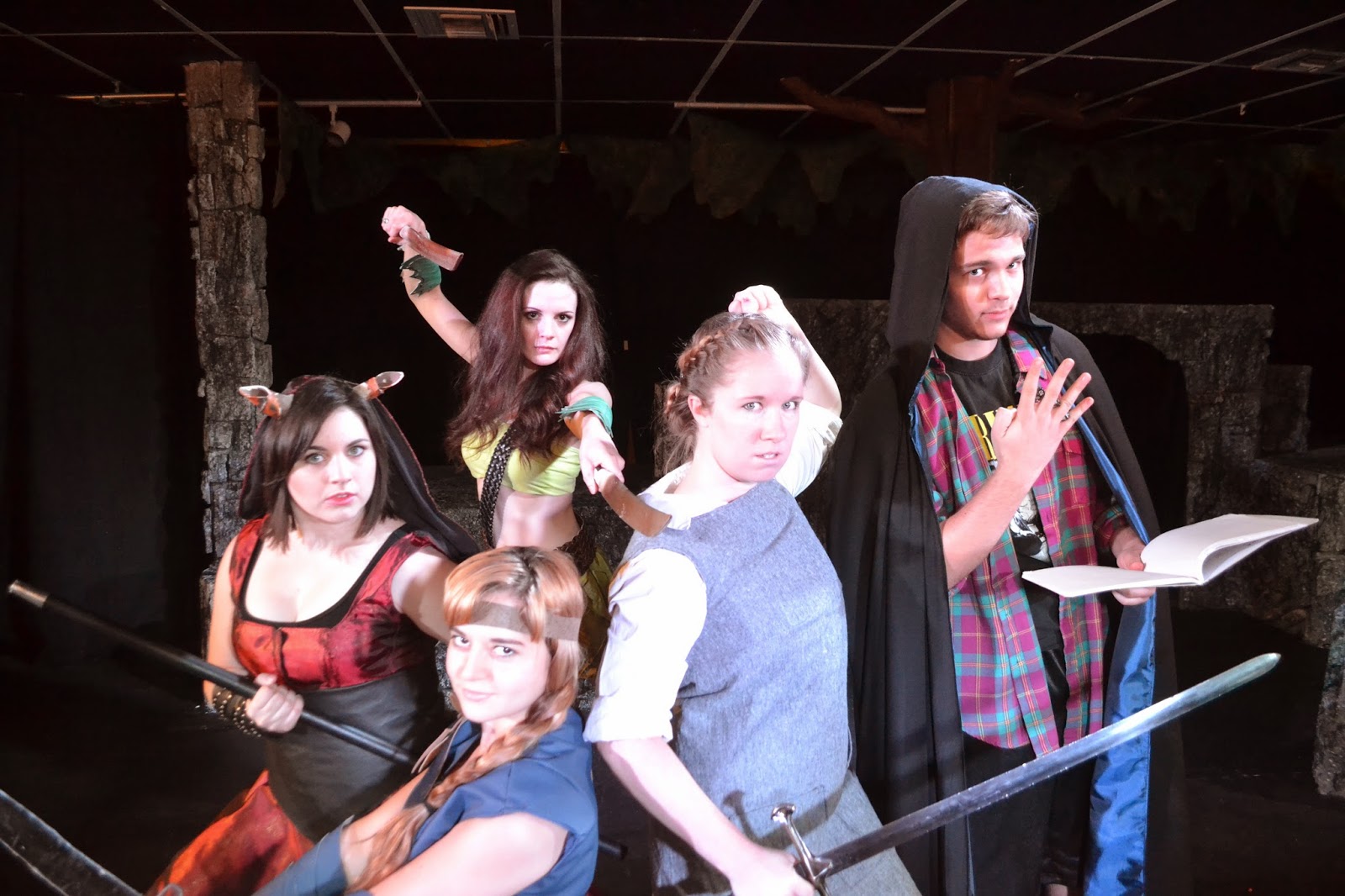
Mia Passarella, Kristiana Faddoul, Melody Knudson, Shelby Maticic and David Magadan
The old fashioned image of a group of young kids getting together and saying "let's put on a show" immediately comes to mind when attending a performance at the Brelby Theatre Company in Glendale. Husband and wife co-founders Brian and Shelby Maticic, both in their 20s, do just about everything from act, direct, write, design costumes and sets and, if required, even coordinate the fight choreography for their shows. They formed the company in 2009 and opened their current Glendale theatre space, located in a storefront on 58th Avenue, in the spring of 2013. They've been producing a season of about six shows a year of original works, classic comedies and even Shakespeare. With a group of gifted, young actors, they are currently presenting a well-directed production of Qui Nguyen's touching comedy She Kills Monsters. Receiving its Arizona premiere, Nguyen's play is a sweet and very funny story of discovery, set inside an action-packed game of Dungeons & Dragons.

Fifteen-year-old Tilly Evans and her parents have recently been killed in a car accident. Tilly's 25-year-old school teacher sister Agnes discovers a notebook that Tilly left behind that lays out a Dungeons & Dragons game she created. Realizing the notebook is a way to discover the sister she never really knew, Agnes seeks out Tilly's teenage friend Chuck to help her navigate her way through the fantasy game that Tilly created. Alternating between the real and D&D worlds, Agnes meets many of Tilly's friends, both real and imaginary, and finds out a lot more about her sister and herself then she ever thought she would.

The play premiered in 2011 and has been performed by many theatre companies across the country. It's well written, has easily identifiable characters, and presents a nice journey of discovery at its core with an abundance of laugh out loud moments. While he uses stereotypical "geek" and "Xena: Warrior Princess" type heroine characters for Tilly's game in the play, Nguyen twists the stereotypes a bit and also shows how Tilly based them on people she knew, which adds a nice layer of realism and emotion. The play is set in the early 1990s and includes many pop culture references of that era that elicit additional laughs.

Brelby's production is performed by an agile and energetic group of young actors led by Shelby Maticic as Agnes and Kristiana Faddoul as Tilly, who are very good at portraying two very different sisters. Maticic easily gets across the serious older sibling, who, at first, is as clueless about role-playing games as she is about her sister, but quickly learns to relish wielding a sword with glee. Faddoul is equally good as the strong character that Tilly becomes within the game and touching in the moments she has with Maticic when the truths about Tilly and her friends come to light.

Mia Passarella and Melody Knudson are powerful as Tilly's warrior friends in the game, Lilith and Kaliope, and each has a scene or two as Tilly's real life friends Lily and Kelly that are equally strong and moving. Passarella is quite effective as the fierce, leather clad dominatrix Lilith and a knock-out as the gentle, unsure of herself Lily. Knudson recently scored in the Hale Centre Theatre production of The Miracle Worker where she portrayed Helen Keller's mother and she is as moving here as the sleek Elfin Kaliope and wheelchair-bound Kelly as she was at Hale. David Magadan gets just about everything right in bringing teenager Chuck to life. He's got the appropriate demeanor and mannerisms of a typical "geek" who at first gets flustered when meeting the older woman Agnes. However, while he has nice comic timing and is impressive with his line delivery, his facial expressions go a little too over the top during his encounter with Agnes and her boyfriend. Still, it is a very funny and worthwhile performance.

Fernando Perez is appropriately immature yet sincere as Agnes' boyfriend Miles, who isn't quite ready to commit after dating Agnes for five years. As Agnes' no nonsense, high-school guidance counselor friend Vera, Colleen Carnahan has a perfect droll delivery. Jose Martinez and Simon Faddoul bring plenty of humor to the couch potato and "Quantum Leap"-obsessed Orcus and the gamer Steve, respectively. Faddoul is very amusing in how he continually gets killed in numerous, comical ways. Willa Eigo and April Rideout are hilarious as the "valley girl" speaking, gum chewing, evil cheerleaders. Jaren Navenma has the perfect dry delivery as the Narrator of the piece, though his voice is sometimes drowned out by the music underscoring. Navenma and DJ Hall also are quite effective as the "movers" during the fight sequences; completely dressed in black and with perfect timing, they pick up the various characters during the action sequences to make them appear as though they are flying through space. It is both humorous and dramatic to watch them work.

Brian Maticic doesn't make any missteps in his direction of the production and his fight choreography is imaginative, abundant, not repetitive and impressive in how it combines fast-paced action with comical and dramatic moments, just like Nguyen's play. He also designed the multi-layered, dungeon inspired set which uses projections and nicely back-lit screens to swiftly change from one scene to the next. He also created the numerous witty puppet creatures our heroines and heroes fight in the game. Carolyn McBurney and Shelby Maticic designed some fantastic costumes that are creative and imaginative and fit perfectly with the characters personas. Jessie Tully's hair and makeup design work wonders in transforming the actors from imaginary characters to real life ones and back again. Nicely used music and sound effects by Luke Gomez help underscore the scenes. Mollie Flanagan's lighting is moody and seductive for the game sequences, but appropriately bright for the real life moments. While Brelby's productions might at first appear to be theatre on a shoestring budget, the Maticics are quite effective in how they manage to do a lot with a little and definitely know how to be successful on a limited budget.

She Kills Monsters is a fast moving, funny and touching homage to the geek and imaginary warrior within us all. With an impressive cast, keen direction and perfectly imaginative creative elements, Brelby's production of the play is a winner. And, as someone who never played Dungeons & Dragons or any other role playing games, I can say that you don't need to know anything about them to understand the journey that Agnes is taking and to be moved by what she discovers along the way.

The Brelby Theatre Company production of She Kills Monsters runs through July 26th, 2014, with performances at 6835 N 58th Avenue in Glendale. Tickets are available at www.brelby.com or by phone at (623) 282-2781

Photo: Shelby Maticic

theatre review CABARET, Desert Stages Theatre, July 13

To read my review at Talkin' Broadway of Cabaret just click on this link.

Terry Gadaire and Marna McLendon

Phoenix theatregoers got a rare special treat this summer, within just a two week period they could see two different versions of the classic 1966 musical Cabaret. First up was a fine productionby the Scottsdale Musical Theater Company of the slightly updated 1987 version of the show and now comes a "perfectly marvelous" production from Desert Stages Theatre in Scottsdale of the 1998 revised script, that runs to August 10th. This more recent version adds some songs written for the 1972 film version but more importantly incorporates elements to ratchet up the shock factor of the story of citizens of Berlin in the early 1930s facing the rise of Hitler. The Desert Stages production is gritty and raw, and is successful in using the intimate playing space to drive home the relevance and immediacy of the horrors of Nazism.

In 1966, book writer Joe Masteroff, composer John Kander and lyricist Fred Ebb created the Broadway musical Cabaret. They based the show on both Christopher Isherwood's 1939 novel "Goodbye to Berlin" that told stories of his time living in Berlin around 1930 and John Van Druten's 1951 theatrical adaptation of the novel, I Am a Camera. Cabaret, set in 1931, plays out against scenes set inside the gritty, decadent Berlin nightclub the Kit Kat Klub, with a mischievous Emcee overseeing the proceedings of its carefree customers while Hitler's rise to power is happening just outside its doors. American novelist Clifford Bradshaw has arrived in Berlin to begin work on his novel. The desperate and recently homeless English Kit Kat Klub headliner Sally Bowles convinces Cliff to let her move in with him, even though they have just met, and they set about forming an interesting living relationship. Cliff's sweet natured landlady, the German Fräulein Schneider, forms a relationship of her own with the adorably charming Jewish fruit seller Herr Schultz. And, even though Sally believes that they have nothing to worry about, and lives her life like it is a never ending cabaret, the rising Nazi regime is about to change everyone's life in Berlin and the world is about to come crashing down in ways no one could possibly imagine.

The updated version of Cabaret more fully incorporates the Emcee into the action of the play to help comment and better focus the atrocities that await the characters. It also stunningly shows how the horrors that are about to come and the desperation of the era culminate in people unable to comprehend the consequence of just what Hitler's power will have on Germany and ultimately the whole world. The extremely intimate theatre in the round stage at Desert Stages is a perfect venue for Cabaret. Not only does it serve well in bringing the scenes set in the smoky dark nightclub setting of the Kit Kat Klub vibrantly to life, but the intimacy of the space works wonders in getting across the emotional aspects of the story. With scenes involving Nazism, characters sporting swastikas and shouts of "Heil!" happening just a few feet in front of you are shocking events that will resonate with you and that you won't quickly forget.
Director Jean-Paoul C. Clemente uses every possible entrance and exit of the space to effectively make us feel as if we are audience members in the club as well as quickly and seamlessly move us from the Kit Kat Klub scenes to the scenes set inside Schneider's boarding house. Clemente also draws refined performances from his cast that quickly establish each character. Jennifer Lee White easily gets across the carefree attitude that Sally has, as well as her self-obsessed nature. While she is somewhat distracting to Cliff's writing of his novel, we also see how she is a unique creature and how she also inspires him. Sally isn't supposed to be a very good singer; she is singing in a run-down nightclub after all, but White bring a nice power and presence to her songs.

Having made a great impression as Henry Higgins in the recent Phoenix Symphony Orchestra/Phoenix Theatre concert production of My Fair Lady, Terry Gadaire is absolutely fearless as the Emcee. He commands the stage, draws attention and has a booming voice that he uses to great effect for his many songs. His take on the Emcee's upbeat songs are flawless, while his interpretation of the ballad "I Don't Care Much" is emotional and stunning, as is his final scene in the show. Clay Sanderson gives Cliff a feeling of hesitancy about the new characters he encounters but also instills a sense of sincerity and recklessness in his dealings with Sally. He has a strength and charm that makes it easy to see why Sally and one of the male dancers at the club are romantically interested in him. His solo song "Don't Go" is delivered with a deep sense of pleading that helps us see how important Sally is to Cliff.

Shari Watts, who was superb as the out of control, pill popping matriarch in Mesa Encore Theatre's August: Osage County earlier this year, is just as effective as Fräulein Schneider. She is warm and realistic in her portrayal of this woman who knows how to survive, whatever the circumstances. When she makes a decision in the second act, which is laid out in her solo "What Would You Do?," it is especially riveting in the emotion and amount of suffering, pain and regret Watts manages to instill in that one moment. Harold LeBoyer is charming as the Jewish Shultz, yet also brings a deep sense of sadness to this man, who, much like Sally, thinks he'll be fine with everything that is going on, just because he is German. Timothy Pittman is charming at first as Cliff's new friend in Berlin, Ernst Ludwig, yet deeply chilling once we see the true feelings of this Nazi sympathizer.

Clemente makes several nice directorial choices including having Ernst start to sing, then speak and finally end up shouting the lyrics of "Tomorrow Belongs to Me," making it eerily reminiscent of Hitler giving one of his speeches. The musical doesn't have an overture, so Clemente has added a short musical segment that has the entire ensemble singing a slowed down version of the title song that beckons all of us to "come to the cabaret." Clemente also choreographed the show with Katy Callie and there are some satisfying touches throughout, such as a bit of a waltz for Cliff and Schneider during the act one song "So What" and having the Kit Kat girls kick line number include Nazi storm trooper inspired movements with one arm raised in a "Heil!" stance. Some of the ensemble members aren't exactly in sync with the various dance steps, but I'm not sure if that was intentional or simply due to lack of rehearsal. However, it actually works splendidly for the show and makes the dancers at the Kit Kat Klub seem as run down and out of sorts as the club itself.

Creative elements are extremely effective. Paul Filan's set design, with painted buildings and bended mirrors on the surrounding walls, smoke continually filling the air, and the combination of Lindsey Ihrig's superb, evocative lighting and Tamara Treat's expressive costumes give the Kit Kat Klub scenes a resemblance of a sultry, seedy, run down leather bar or S&M club. But the design just as quickly becomes the bright, sunny rooms of Schneider's boarding room house. Filan uses small rolling tables that are easily reconfigured to represent just about every required piece of furniture in the show. However, the lack of any physical doors in the design does make a few plot points, such as Schultz being caught coming out of Schneider's room, confusing or nonexistent. Treat's costumes that combine leather boots, corsets and fishnet stockings do make the Emcee look like he could just as easily play "Frank 'N' Furter" in a production of The Rocky Horror Show, but the combination of colors and fabrics work, as do the creative hair and make-up designs. The ones for Sally make her resemble a beaten down Ava Gardner.
Cabaret at Desert Stages Theatre is dark, raunchy and shocking, yet has an immediacy through the raw emotions of the story and how identifiable the situations and circumstances of the characters are and the horrors that await them. While it may not be every theatregoer's cup of tea, especially those who prefer more traditional G rated shows like The Sound of Music or My Fair Lady, with excellent creative elements and an inspired performance by Terry Gadaire as the Emcee, this production is highly recommended.

For this show, DST has added special VIP table seating on the two raised balconies that gives an interesting view of the proceedings and also comes with chocolates and a bottle of sparkling cider or water.

The Desert Stages Theatre production of Cabaret runs through August 10th, 2014, with performances at 4720 N. Scottsdale Road in Scottsdale. Tickets are available at www.DesertStages.org or by phone at (480) 483-1664.

Photo: Heather Butcher

Thursday, July 17, 2014

theatre review PETER PAN, Arizona Broadway Theatre, July 11

Click here to read my review below at Talkin' Broadway of Peter Pan at the Arizona Broadway Theatre.
David Errigo, Jr., T.J. Rossi, Tristan Klaphake and Sarah Powell
About to celebrate its 60th anniversary, the classic family musical comedy Peter Pan has landed at Arizona Broadway Theatre in a spirited, colorful and, yes, "high flying" production that goes slightly against the tradition of previous Pan productions by casting a young man as Peter. Mary Martin famously brought J. M. Barrie's classic literary character to life in the 1954 Broadway musical, and then played him in three well received TV productions of the show. Other memorable mountings over the years featured Sandy Duncan and then Cathy Rigby as Peter, but having a young man in the part brings a new natural dimension to the character that serves the story well. The ABT production is appropriately light and comical but with a huge heart at the core.

Living far away from London on the island of Neverland with a group of other Lost Boys, the magical Peter Pan is a boy who refuses to grow up. After Peter and his mischievous fairy Tinkerbell visit the Darling family nursery in London one evening, a sprinkling of fairy dust and happy thoughts whisks the Darling children, Wendy, Michael and John, away to Neverland. Their non-stop adventures include encounters with pirates, Indians, mermaids, a crocodile who swallowed a clock, and the deliciously evil Captain Hook. The score, with music by Moose Charlap and Jule Styne, and lyrics from Carolyn Leigh, Betty Comden and Adolph Green, features such classic songs as "Neverland," "I'm Flying" and "I Gotta Crow."

David Errigo, Jr. affects a prepubescent voice to give Peter a youthful exuberance. His athletic physique adds a nice element of strength to Peter's dancing and flying movements and he instills a rousing, boyish charm in every line delivery, gesture and facial expression that culminates in a winning performance. However, since the score was originally written for a female to play the part, the changed keys for a male voice don't quite sit as well or allow Peter's songs to soar quite as much as they do when a woman plays Peter.

Jeremy Crawford and Kiel Klaphake
Kiel Klaphake seems to relish playing Peter's enemy, the dastardly Captain Hook, wringing the comical lines for all they're worth, but stopping short of chewing the scenery. And while his Hook is devilishly delightful, his portrayal of Mr. Darling is equally touching and sincere. The two performances are so distinct and different that it's hard to believe they are both played by the same actor. Klaphake also has a rich voice that he uses to great effect on Hook's songs.

Sarah Powell makes Wendy the rightly prim and proper English girl in her stern maternal dealings with Peter and the other boys but also adds a nice touch of sweet romanticism in portraying her school girl crush on Peter. Sure, we know Powell and Errigo aren't really youngsters, but they both do a remarkable job of making us believe that they are. Alissa Tucker gives Tiger Lily, the leader of the Indian tribe, a fierce strength, and Jeremy Crawford as the bumbling pirate Smee steals just about every scene he is in.

Director Mace Archer nicely balances the comical moments with the serious ones and choreographer Kurtis W. Overby provides plenty of energy, including a rousing "Ugg-a-Wugg" that has the entire ensemble banging on drums in well-choreographed, synchronized movements. Creative elements, as usual at ABT, are top notch, with colorful and creative sets by William Boles that include some nice comical scenery additions to the flying sequence over London. Creative costumes by Christianne Myers and vibrant lighting by Will Kirkham that paints the stage in rich, deep purples, reds and blues effectively combine with the scenery to perfectly delineate the more serious scenes in the Darling nursery from the comical and adventurous ones in Neverland. The flying effects by ZFX, who also provided the effects for the Rigby productions, are magical and include an abundance of flying throughout the show. The flying includes more than just having the actors swing back and forth and up and down across the stage as is done in many productions. ABT audiences get an additional bonus as, according to a ZFX spokesperson, an added flying rig that sends Peter out over the first few rows of the audience is something that only about 20% of the theatres that stage the show are able to accommodate.

With many well-known classic show tunes, plenty of adventure and many humorous situations, Peter Pan is an enchanting journey. The ABT production soars with its flying effects, fine cast and beautiful creative elements, but also is perfectly earth bound in honoring the rich emotional messages at the core of the story. As a true sign that the magic of theatre is alive and well, at the opening night performance, at the crucial moment in the show when Peter asks the audience if they believe in fairies, one young audience member in the front section, rapt in attention, immediately commented "I believe in fairies." The genuine, soft spoken yet completely serious statement quickly brought gasps and, I can imagine, more than a few choked up tears for those in the audience, and even caught Errigo off guard with the magic that only live theatre can create.

Peter Pan runs through August 17th, 2014, at the Arizona Broadway Theatre, 7701 West Paradise Lane in Peoria. Tickets can be ordered at azbroadway.org or by calling 623 776-8400.

Photos: Mike Benedetto / Arizona Broadway Theatre

Tuesday, July 15, 2014

theatre review FOOTLOOSE, Hale Centre Theatre, July 10

Click here to read my complete review (highlights below) at Talkin' Broadway of Footloose at the Hale Centre Theatre.

It's hard to believe that it has been thirty years since the movie Footloose was such a huge hit at the box office. The soundtrack, with such songs as "I Need a Hero," "Let's Hear It for the Boy," "I'm Free" and the title song, was also a smash, holding the #1 spot on the US Billboard 200 chart for over two months. While the film wasn't an actual musical, since none of the characters sang any of the songs, in 1998 the movie was adapted into a Broadway musical featuring many of the songs from the film along with additional ones written by Tom Snow and Dean Pitchford, both of whom had written songs for the movie soundtrack. A fun, upbeat coming of age story with a big message about the need to fit in and the desire to change people's lives for the better, Footloosewas the perfect feel good summer movie, and the musical is equally as fun, filled with lots of dancing and buoyant, infectious songs. With a cast of young gifted actors and singers, the Hale Centre production that just opened is a skillfully sung and danced show that offers a fun and joyous night out.

High school student Ren McCormack and his mother have just moved to the small town of Bomont from Chicago after Ren's father deserts them. They've moved to Bomont to live with Ren's aunt and uncle, and Ren quickly realizes that his Chicago style and way of doing things clashes with the small town's rules, specifically one enforced by the local minister Reverend Moore that bans dancing and rock music due to their negative influences on the children in town. Of course, when Ren falls for the minister's daughter Ariel it only makes matters worse, especially since Ren's outgoing personality is seen as a negative influence. Ren sets out to discover the reasons behind the ban on dancing as well as a way to bridge the gap between himself and the ultra-conservative Moore.

Footloose is a show that requires a lot of dancing and director/choreographer Cambrian James has assembled a terrific cast that more than manages their way around the varied and exuberant steps he has created for the show. Connor Wince easily makes Ren the likeable outcast who is just trying to fit in, and his exuberance is displayed through exceptional and impressive dance moves, including an abundance of acrobatic flips. He has a pleasant signing voice as well as an assured delivery of his dialogue which contribute to a nice interpretation of the role.

As Ariel, the minister's daughter who falls for Ren, Jacqueline Brecker gets across that Ariel is smart and funny and knows exactly what to do in order to get what she wants. She brings a nice energy to her performance as well as a voice that solidly negotiates the pop/rock score. While she and Wince come across more as good friends who might be interested in each other, instead of a couple in a relationship with sultry, burning desire at its core, they do have one passionate kiss that adds a bit of heat to their G-rated romance.

Brandon Zale is appropriately righteous and stern as Reverend Moore, but instills the part with an element of compassion and understanding that I've not seen in previous productions. He makes Moore sympathetic and not an out and out villain, which works well. He also has a rich and powerful singing voice that he uses very effectively for Moore's songs. Brandi Bigley and Jennifer Whiting deliver touching and heartfelt performances as the moms of Ariel and Ren, respectively. They don't have a lot to do in the show, but Pitchford and Bobbie have given them both rich, clear and succinct dialogue that, when combined with Bigley and Whiting's genuine performances, manages to do a lot with a little.

Kate E. Cook and Danny Karapetian are fantastic as Rusty and Willard, Ariel and Ren's friends who have a budding romance of their own. Cook has one of the strongest, clearest voices in the non-professional Phoenix Theatre scene, managing to make an excellent impression in every role she performs, and she more than succeeds as the fast talking Rusty. Her delivery of "Somebody's Eyes" is superb. Karapetian is just as good as the slow-witted but endearing and charming Willard. He provides a skilled delivery of Willard's humorous lines and excels in his solo comical song "Mama Says."

James' staging is fantastic and his dance steps are continually changing from song to song. He proficiently fills the entire stage, the staircases, platforms and entry ways with his cast during "Somebody's Eyes," which ties in perfectly with the song's lyrics about how, no matter where you go, "somebody's eyes are watching." For the dream sequence delivery of "I Need a Hero," he expertly has his ensemble maneuver four large tables into a rotating platform for Brecker, Cook and their friends to perform upon, and then just as quickly move them back as if the dream never happened. I also like his honky tonk staging of the country inspired "Let's Hear It For the Boy" that Cook knocks out of the park while the ensemble delivers some nice line dancing steps. James' only misstep is a slightly muddy and cluttered opening sequence for the title song that has his cast performing some awkward movements. Fortunately, that and the slightly non-passionate relationship between Wince and Brecker are the only very small negatives in the whole production.

Creative elements, as usual with a Hale show, are excellent. Set designers Adam DeVaney and Brian Daily use an abundance of small moveable set pieces to whisk us from one location to the next, Mary Atkinson's costumes are colorful, character appropriate and abundant, and Jeff A. Davis' lighting design provides appropriately bright sequences for the daytime scenes and plenty of shadows and darkness for the evening ones. He also uses a lot of effective "rock star" style lighting for the upbeat songs. While there were a few small sound glitches, I have to believe they were just opening night kinks still needing to be worked out.

Footloose is a fun-filled show perfect for the hot summer months. It's fun, fast and brimming with singing and dancing. The Hale Centre Theatre production has excellent choreography and a hard-working cast that manages to instill this simple story with a shot of charm and sincerity on top of a wealth of nonstop dancing.

The Hale Centre Theatre production of Footloose runs through August 23rd, 2014, with performances at 50 W. Page Avenue in Gilbert. Tickets can be ordered at www.haletheatrearizona.com or by calling (480) 497-1181

Photo: Nick Woodward/Hale Centre Theatre

theatre review THE AGONY AND THE ECSTASY OF STEVE JOBS, Actors Theatre, July 9

To read my Talkin' Broadway review of The Agony and the Ecstasy of Steve Jobs at Actors Theatre just click on this link.

Ron May
American playwright, monologist and performer Mike Daisey created quite a stir in 2010 with his one man show The Agony and the Ecstasy of Steve Jobs. The ninety minute monologue delves into the history of technology giant Apple, its co-founder and former CEO Steve Jobs, and the specifics of how many of the world's electronics, including products from Apple, are made in China under harsh work environments. Daisey and his play won accolades for the powerful storytelling and the ability to make us think about just what goes into making our electronic devices. While it was later revealed that Daisey exaggerated or dramatized a few of the items, facts and encounters in his monologue, it is still a stirring analysis of the world's fascination with technology and the cost that allure entails. Actors Theatre presented the play back in the Fall of 2012 and they've brought the show back for a return engagement for a few performances this month as part of their Summer Series. Ron May, the Founding Artistic Director of Stray Cat Theatre, who starred in the previous production, returns for this encore presentation.

According to Daisey, about half of the electronics made in the world are manufactured in one single factory complex in Shenzhen, China by a company called Foxconn. While most of us think everything today is made by machines, that is actually not the case, as the low cost of wages in China means thousands of hands are working, essentially around the clock, to make the latest "must have" electronic gadget. The stories of the inhumane working conditions of these workers in China, and the details of Daisey's visit to Shenzhen make up the "agony" in the title of the play. Daisey's passionate words tell of over 400,000 workers in China, some working 12-16 hours a day, at low wages, doing repetitive motions with their hands that make them virtually useless within ten years. A series of suicides, with workers jumping off the top of the large Foxconn buildings in Shenzhen, can only be assumed to be attributed to the conditions of working at Foxconn.

But Daisey effectively balances the horror stories of the workers with the fascinating story of Apple and the rise, fall and rise again of Steve Jobs and the world's fascination with the sleekly designed products from Apple. The humorous tales of the mystical, God-like Jobs, and of our intense focus on having latest and greatest electronic gadgets form the "ecstasy" in the play's title. These humorous and absorbing stories counter the dramatic tales of the workers in Shenzhen to form an illuminating piece that really makes you think about everything that goes into making that electronic device in your hand, pocket or purse. Daisey obviously wants to raise awareness of the inhumane working conditions in China, and alternating the story of his trip to Shenzhen with the story of Apple's success culminates in a play that resonates with tech heads, geeks and just about anyone who has ever wondered what went into making their phone and other devices. Though, for those less tech savvy, or those less familiar with Apple and Jobs, it might be just a bit boring. This production, like the one two years back, is the edited version of the play that eliminates the fabricated items that Daisey admitted to making up. And, while the majority of Daisey's verbiage is focused on Apple, he does mention several times that Apple isn't the only company involved in the manufacturing of products in China in grim working conditions.

Ron May is splendid as Daisey, with an intense, natural delivery of the words that makes you believe May himself actually visited Foxconn and had intimate details of the creation of Apple. I have no idea if May is actually a self-proclaimed geek, techie or Apple product aficionado who takes his MacBook apart to clean every piece in detail, as Daisey admits to doing in the monologue, but based on May's intense, realistic performance, I'm prepared to have him help me with all of my computer needs. May also relishes the humor in the script, with a spirited delivery of the comic lines as well as a nice ability to use different voices to portray the various characters in the piece, such as Apple's co-founder Steve Wozniak. It is an impressive performance.

Matthew Wiener's direction allows the clear storytelling and May's performance to flow naturally, with appropriate movement around the stage when necessary. Tim Monson's lighting design is simple and clean, providing a nice balance of light that complements Daisey's stories and May's performance.

Daisey's play is a funny, sharp and pointed monologue, and the combination of Daisey's words and May's delivery form an immersive exploration of Apple, Jobs and our focus on technology. It might make you feel a bit uncomfortable and make you think a little differently the next time you go to look at your phone, laptop or any fancy electronic item, which is exactly what Daisey was attempting to do. The Agony and the Ecstasy of Steve Jobs and Ron May's outstanding performance tell a tale that will slowly gnaw away at you and really make you think.

The Actors Theatre production of The Agony and the Ecstasy of Steve Jobs plays again on July 12th and July 23rd, 2014 at the Black Theatre Troupe/Helen K. Mason Performing Arts Center, at 1333 East Washington Street in downtown Phoenix. Tickets can be ordered at http://actorstheatrephx.org/ or by calling (602) 888-0368

Photo: John Groseclose