Jackie Hoffman might just be the funniest person currently working in the New York Theatre. In addition to her hilarious supporting turns in the original Broadway casts of Hairspray, Xanadu and The Addams Family, Jackie has continually crafted solo comedic shows that she has performed in various venues. Last year her one woman take off of A Christmas Carol with the simple title of Jackie Hoffman's A Chanukah Carol, was such a hit that she brought it back for an additional series of performances. With the tag line "All New (unless you saw it last year)" you get an idea of Jackie's type of humor.
The hour long show, co-written and directed by Michael Schiralli, starts with Jackie doing her show at Beth Temple Shalom in Queens to a very unappreciative and hostile audience. The cranky and kvetching Hoffman assaults the audience, leaves the stage and decides to calm her nerves with some pills and a little Manischewitz wine. Of course that toxic combination finds Jackie in a delusional state where she is visited by the infamous three Carol ghosts of past, present and future. Can what the ghosts show Jackie help turn her from her self depreciating and self loathing ways to see how lucky she has it and see the true spirit of Chanukah? Well with Hoffman's acid tongued humor all bets are off if she really will see the error of her ways or stay the cranky comic we all love.
With no props or sets and just two chairs, Hoffman conjures up not only various members of her family, especially memorable in several dinner scenes where there is an overabundance of food, Jewish stars Molly Picon and a spot-on imitation of an always hungry Shelly Winters as two of the ghosts but also even does a pretty good take on Patrick Stewart as the narrator of the entire show. For those of you wondering why Stewart is included in Hoffman's crazy show, he did a very famous one man Christmas Carol on Broadway in the 90's to great acclaim, so of course it makes sense to include him.
Jackie is so genuine in her approach to displaying what we have to believe are scenes somewhat based on her actual life that you easily identify with her and her experiences. From being the self obsessed teen, willing to work on the Sabbath and the Jewish Holidays to become the famous person she longs be to the semi-famous comic hoping for success on Broadway, they are all traits we can identify with as we all yearn for our own chance of success even if achieving it comes at a cost.
Now, a one woman show can lose steam even at an hour, and Jackie does manage to include a few moments that don't land, including an ending that doesn't have as big of a finish as I'd hope for. However, there are many that do. The scene with her family where they are wondering what the exact difference between Diet Coke and Coke Zero is becomes almost as hilarious as the infamous "Who's On First" Abbott and Costello routine. And how Jackie shoe horns in the character of Tiny Tim, reimagined as Tiny Kim, a Thai delivery boy from Pinkberry who gives Jackie a detailed analysis of her entire career was one of the many highlights of the show.
To see where Jackie is performing next check out her official website.
Jackie dons many wigs in this "review" of the show:
Les Misérables is one of those stage to screen musical adaptations that gets most things right in the transfer from live musical to celluloid experience. As one of the most successful stage musicals, Les Misérables is a worldwide phenomenon so it seemed only natural that a film version would eventually happen. However, the fact that it took almost thirty years since it first premiered to become a film is something that I don't think anyone expected.
Based on the classic novel by Victor Hugo, and set in the early to mid 1800's, Les Misérables tells the epic story of Jean Valjean who was jailed for stealing a loaf of bread to feed his starving nephew. His original five year sentence becomes almost twenty after he tries to escape making him a very bitter and desperate man. However, when a bishop saves him, that act of kindness that gives him a second chance and how that event turns him into a positive force is the original tale of "paying it forward." His redemption and how that changes him is the force behind the emotional journey of the story while the fact that he did run away to become someone else and is being hunted by a police inspector is the major driving element behind the plot.
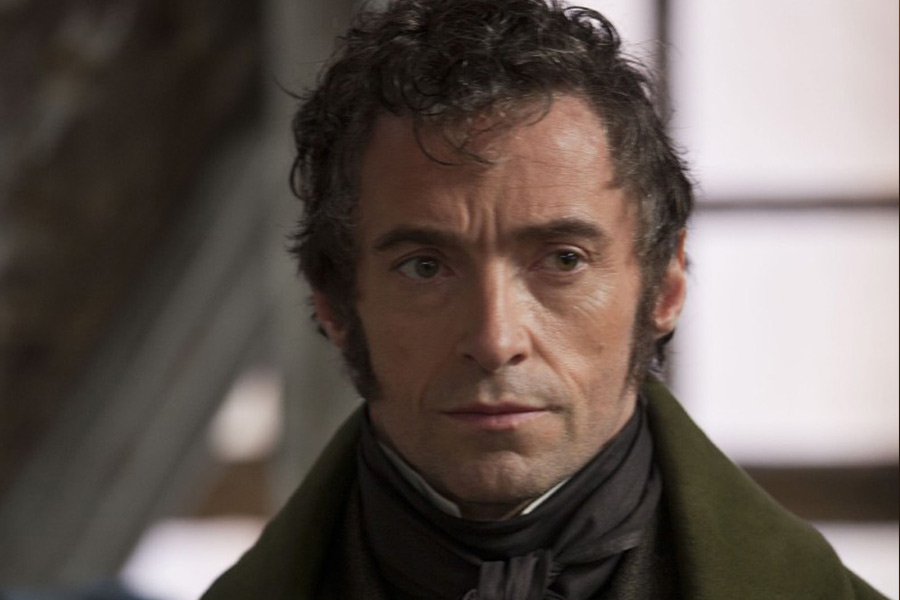
Hugh Jackman as "Jean Valjean"
As Valjean, Hugh Jackman is giving a stellar performance, one that not only just earned him a Golden Globe but also an Oscar nomination. Much has been written about how director Tom Hooper had the actors sing live during filming instead of lip syncing to a pre-recorded audio track. This tactic allowed the actors to not only provide more emotions to a song based on being in the moment on set verses being in a studio weeks or even months before shooting actually began and they had a chance to become and discover their characters but also allowed them to try various takes on the songs during the filming process. Jackman benefits greatly from this choice. His two dramatic solos in the film, "Valjean's Soliloquy" and "Who Am I?" are so full of emotion seemingly derived from that exact moment the film was shot that I don't think he would have won that Golden Globe if the songs had been pre-recorded.
Anne Hathaway as "Fantine"
Likewise, Anne Hathaway also benefits from this filming choice. Her "I Dreamed a Dream," arguably the best known song from the show, is delivered in one seamless take that perfectly captures the anguish of her character Fantine and the journey her character has been forced to take. It is an extremely memorable and heart wrenching moment and I have to believe that Hathaway is the front runner for the Oscar for Supporting Actress after already winning a Golden Globe as well as numerous other awards for her performance.
Russell Crowe is Javert, the inspector who makes it his lifelong mission to hunt Valjean down and while Hooper mentioned he cast actors who could sing instead of singers who could act, Crowe is able to hold his own against his more vocally gifted co-stars. Sure Crowe's voice is a little on the softer and gruffer side, but I liked the way his singing was more internal and seemingly coming from an unbalanced man, which was clearly in line with the character of Javert. While he can't hold some of the notes as long as some of the stage Valjean's have, I thought his performance was as calculated as his character is and I like it more and more that I think back on it.
Russell Crowe as "Javert"
Several of the supporting cast fair pretty good, particularly Eddie Redmayne as Marius who has a certain beauty in both his acting and singing that connect very clearly with the material. Samantha Barks as Eponine and Aaron Tveit as Enjolras are two actors who have performed in numerous musicals in London and Broadway respectively, so their voices are the best in the film, but they both are also perfect in their parts with Barks especially touching as the girl in love with someone who doesn't love her back and who knows it.
Amanda Seyfried as "Cosette" and
Eddie Redmayne as "Marius"
Amanda Seyfried is Cosette, Fantine's daughter who Valjean adopts and who Marius loves. And she is fine in the part, which of all of the roles has probably the least amount of good material to latch onto. As the comic duo the Thénardiers, Helena Bonham Carter and Sacha Baron Cohen play Eponine's parents and Cosette's original caretakers who factor into many of the plot points. While both are clearly up to the challenge of the material, and I especially liked Bonham Carter's contributions, fortunately Hooper and the other contributors have wisely cut back on some of their material that was in the stage version in order to not have the comical moments over shadow the more serious ones of the film.
Samantha Barks as "Eponine"
Colm Wilkinson who created the role of Valjean both in London and on Broadway plays the part of the Bishop whose actions are the catalyst for Valjean's journey. It is a great touch to have Wilkinson in the film and playing this part and he expertly delivers what is needed.
William Nicholson has taken the original sung through musical and made changes to the script both alone and in consultation with the original French creators Alain Boublil and Claude-Michel Schönberg, English librettist Herbet Kretzmer as well as producer Cameron Mackintosh to fill in some of the more vague moments of the musical. By adding in some things from the original novel, as well as moving some of the songs around, the overall effect is a tighter show with a clearer dramatic arch. The movement of two of the big songs, Fantine's "I Dreamed a Dream" and Eponine's "On My Own" to be in more dramatic moments of their character's journeys are two simple changes that made me think "Of course it makes more sense to have those songs at those points in the show." I'm curious to see if those same changes, or at least the movement of "I Dreamed a Dream," are made for future productions of the stage version.
Helena Bonham Carter, Sacha Baron Cohen
and Isabelle Allen
The look and feel of the film is similar to what Hopper did with the tv mini series John Adams that he also directed, it has a gritty, bleak look, seemingly in tone with the time period the film is set in. Hopper also chooses to shoot most of the solo songs in close-up with minimal cuts. This gives a more direct, internal feel to those monologues which works very well in my opinion. Are there some quibbles I have with the film? Of course. Some scenes that are shot in harsh daylight could have benefited from more moody evening lighting. Seyfried's singing is a little thin especially around the higher notes. The main plot point of the second half of the film, around the student's revolt and the building of the barricade is still a little unclear and I miss a few things from the stage show like the use of the ghosts during "Empty Chairs at Empty Tables." But this film of Les Misérables is one that I will gladly revisit again and again. Is this the greatest movie musical ever, no, but is this a story of such emotion and depth, most definitely.
While the film is still in theaters, the blu ray/DVD has just been announced with a March 19th release date. Amazon link for the blu ray/DVD is below.
A sudden opening in George Street Playhouse's already announced season could have had a horrible ending with an under rehearsed, quickly put together production. However, sometimes a potentially bad situation can turn out to be good in the end as fortunately the Barrington Stage Company's recent production of The Best of Enemies was able to be remounted at George Street with most of its cast intact in a stellar production that just concluded a month long run.
Based on the best-selling book by Osha Gray Davidson, The Best of Enemies tells the true story of the relationship that develops between the African American civil rights activist Ann Atwater and C.P. Ellis, a Grand Master of the KKK. They are two people at odds, brought together in 1971 during the court ordered desegregation of the Durham, NC schools. The Best of Enemies is a play of prejudice on both sides of an issue but also one that shows when two people are fighting for what they believe in, and are forced to face their enemy head on, they start to realize they are both very similar in the passion behind their beliefs. Of course there is good and bad on both sides of the issue with both characters passionately backing up their beliefs.
John Bedford Lloyd and Aisha Hinds
Written by Mark St. Germain and directed by Julianne Boyd, who also directed the production at the Barrington Stage Company, the play focuses on the time when Atwater and Ellis were basically coerced by a federal mediator from the Board of Education to sit on the steering committee in order to represent the views of the community around the segregation of the schools. On one side you have a woman speaking up for justice and equal education but also someone who has no love for those on the other side who promote white supremacy. The old saying "keep your friends close, and your enemies closer" came to mind why the play was unfolding as both Atwater and Ellis are forced to deal directly with their opponent and in doing so end up understanding each other better. But this is also a tale of redemption and how people can grow and ultimately change by understanding where their enemy is coming from, and in doing so, can actually forge a very unexpected friendship. It is inspiring and gripping with all of the ugliness of the events intact and also a compelling story that makes you sit up and pay attention to real events that happened just forty years ago.
Aisha Hinds, Don Guillory and John Bedford Lloyd
The production couldn't have found two better actors to portray the two lead characters. Aisha Hinds is Atwater and John Bedford Lloyd is Ellis. Hinds perfectly plays the struggling single mom who has no fear of men, let alone Ellis. She is more raw and emotional than Lloyd as Ellis but also plays a character who has much more to lose. She is also playing someone much older then she really is and also one with some physical difficulties, which she never lets slip throughout the entire play. Hinds expertly plays the skeptical parts of the character as well as easily gets across the natural humor that can come with being placed in an uncomfortable situation.
Lloyd on the other hand has more of a journey and a harder character to play since he has to not only play a racist but one that has to not only win over Atwater but the audience with the journey his character takes. He pulls no punches in his delivery of the racist language, hateful looks and body language of Ellis and fortunately St. Germain and Boyd aren't also afraid to be up front and direct with making sure we clearly see the danger that lurks in this hateful man. He is frustrated and desperate to fight something that he believes will negatively impact his life and the entire nation. However, the three have also crafted a character that we see change in front of us and start to empathize with, something that we, just like Atwater, must witness unfold before us to not only understand this man but also to help us better understand ourselves.
Don Guillory is the mediator Bill Riddick and he is presented as a black man who is cocky but intelligent, which rubs both Atwater and Ellis the wrong way. But he knows that both of these community "leaders" are people who are strong in their beliefs and he realizes the best way to make progress is to bring Atwater and Ellis together so they can realize how alike they really are. Guillory is all smug and passionate as well about his beliefs and how his idea ultimately makes things better but well directed by Boyd to not overpower the two leads. Susan Wands is Ellis' long suffering wife Mary and is just as sympathetic in her portrayal as the other characters. She is presented as racist as well, but one who more quickly understands the shortcomings of her views when confronted with a personal issue.
The play is presented in linear fashion and in doing so makes the audience better understand why someone like Ellis believes the things he does and why Atwater is so passionate as well. I was even pleasantly shocked that I cared so much for Ellis as much as I did which can be attributed as much to St. Germain's writing as the performance from Lloyd and the direction from Boyd. And the reason I cared so much for him is that he was presented as a real person, one who believed certain things but when forced to meet his "enemy" head on starts to doubt his believes, his upbringing and the people around him. He changes, but so does Atwater, who is also presented just as passionately and real as Ellis. In doing so St. Germain has created a cathartic experience for the audience to take the journey with these two characters. Knowing that these two people were real, and that the unlikely events of the play actually happened takes the whole play to an even higher level. That is why this is a play that I believe will have a very healthy life in regional theatres as it is a small play with a small cast but with a big message that makes you believe in the power that people can change for the better.
Christmas concerts with symphony orchestras are a holiday staple in every city around the world. Fortunately in New Jersey this holiday season we were treated to two enjoyable concerts, the first one featuring The Boston Pops at their holiday concert tour stop at the New Jersey Performing Arts Center and our second concert was with our own New Jersey Symphony Orchestra with their special guest Ann Hampton Callaway at the State Theatre in New Brunswick. And while The Boston Pops are more well known then the NJSO, it was actually the NJSO concert that was more enjoyable and more memorable.
Now don't get me wrong, the Boston Pops are a great orchestra and under the direction of Keith Lockhart they always provide an engaging, joyous holiday show. But I thought the set list was somewhat tired and even with the addition of the vocal ensemble Five by Design who joined the Pops on several songs and gave them a fun 50's feel as well as having Meredith Vieira read "Yes Virginia, There is a Santa Claus" accompanied by the Pops, the whole concert just seemed a little flat.
The NJSO concert, led by guest conductor John Morris Russell from the Cincinnati Pops, featured a varied set list that included many surprises. Ann Hampton Callaway was the special guest and she provided a warm and personal touch to the many holiday classics she sang- some with the entire orchestra, and a few with a trio. The highlights for me included Ann's take on "My Favorite Things" as well as "Carol of the Bells," "Have Yourself a Merry Little Christmas" and "Winter Wonderland."
Ann also performed some of her original songs as well including "Christmas Lullaby" that Barbra Streisand recorded and a hilarious one she wrote on the spot after taking lyric suggestions from the audience. Ann knows how to connect with an audience which added a nice sense of humor as well as a personal connection to the evening.
What I also enjoyed so much about the concert was the orchestral pieces that weren't exactly traditional holiday fare, yet had a holiday connection, like Rimsky-Korsakov's "Dance of the Tumblers," Bizet's Farandole Suite from L'Arlesienne and a lovely pairing of "Winter" from Vivaldi's Four Seasons and "Hanukkah, Oh Hanukkah" that they title "A Winter Miracle." This pairing was a simply fantastic arrangement that merged the two songs seamlessly into an even greater piece of music.
The Masterwork Chorus provided a lovely rich choral sound to several songs including Handel's "Messiah," and "Deck the Halls" Ann joined them on the Handel piece as well as led them with a moving performance to John William's "Somewhere in My Memory." The concert ended with an emotionally uplifting "Go Tell It On the Mountain" that featured a rousing take on the gospel classic by the orchestra, Callaway and the Chorus.
The musical Bare, that just opened Off Broadway, is a show that has been around for about ten years now. While there have been several other productions in the US, this production is the first one to open in NY Off Broadway as an open ended run. This is also an updated version of the show with numerous changes made to bring the story to current times as well as add a large amount of dialogue that was missing in the previous "rock opera" version of the show. While this updating was beneficial, and the added dialogue makes the more traditional musical more accessible, Bare is still a show that tells a story we've pretty much all seen before. And, the overly amplified and at various times screaming pop music detracts from the several songs in the show that are excellent musical theatre character driven songs. Still, Bare is a good musical, it just isn't a great one.
Bare is the story of two high school boys who are in love. The fact that they attend a Catholic High School and one of the boys is a semi-closeted nerd and the other a closeted jock only adds to the drama. Add to the mix a straight couple who have their own issues, including the girl of that couple falling for the closeted jock, drug use in teenagers, the views of Catholicism on homosexuality and your usual teen angst and you have two hours of teen drama that, as I said before, we've pretty much seen before in various after school specials, movies of the week and "special" episodes of tv dramas.
Taylor Trensch and Jason Hite
While Taylor Trensch and Jason Hite are quite effective as Peter, the nerd and Jason, the jock, either both of them were having a slightly off night vocally or they weren't exactly cast for their soaring vocal abilities. They are very effective in their portrayals of these two lost boys who find themselves when they find each other, I just wish their voices were more up to handle the challenges of the pop rock score.
And while most of the rest of the supporting characters were one dimensional, mainly due to the book of the show and not the actors, I really liked Barrett Wilbert Weed who plays Jason's drug dealing sister, Elizabeth Judd as Ivy who had some scandal in her past that made her transfer schools and Gerard Canonico as Matt, who is in love with Ivy and hopes that she is really in love with him. Missi Pyle as Sister Joan, the one compassionate teacher at the school was quite effective not only in this part of a caring and thoughtful teacher but also as the "dream" Virgin Mary who comes to answer Peter's "911" call. Pyle was able to handle the demands of the score but even Wilbert Weed, Judd and Canonico struggled a bit, which makes me believe the casting for the show was more focused on finding actors who can sing then singers who can act.
Barrett Wilbert Weed and the cast
Damon Intrabartolo composed the score for the show with book and lyrics by Jon Hartmere. Lynne Shankel also contributed additional music. There is much to like in the score with various styles of music and some touching ballads and duets but again, several of the songs have the ensemble screaming their lungs out with most of the lyrics unintelligible.
Stafford Arima directs this production and it is interesting that he decided to direct this show considering earlier in the year he directed the off Broadway production of Carrie, which is also a show set in a high school with plenty of religious overtones. Arima manages to keep the action moving and focused as well as effectively uses the set in staging the various locales of the show, but I wish he had found a way to better focus the parts of the show where the cast is basically just screaming out the lyrics.
I did like the set design by Donyale Werle, it was simple, yet effective with a couple of moving walls to signify the various rooms at the school. The use of projections by William Cusick was also a nicely dramatic and theatrical element and quite effective in the ease of showing pictures of the cast since several photos they've taken for school projects figure in to the plot.
Bare is one of those musicals where there are about six or seven really good songs surrounded by others that are just so-so. With two leads and a talented ensemble, a nice set design and serviceable direction it manages to effectively get across the message behind the issues surrounding the teenage characters in the show. I just wish there was less screaming and slightly better singers in the cast.
The Broadway musical Wicked is a phenomenon. Having run for over nine years and launched National Tours, a production that is still running in London and various other productions in other cities around the world, it is a show that many people have seen, including many people who have seen it many times. We fall into that later category having attended the show something like five times during the first two years of its Broadway run.
So with relatives coming to town who wanted to see the show, we got tickets and it was very interesting seeing this production with a cast we'd never seen before and a show we hadn't seen in something like seven years. Wicked is a show that definitely has its haters, but there is so much to connect to in the show and so many different themes and layers that it is no wonder that so many people like it and, like us, have returned to it over and over again.
Telling the back story of the Wicked Witch of the West and how she got to be that way and given that name, the musical is based on the best selling novel of the same name by Gregory Maguire. And while the main theme and characters of the musical are the same as the novel, there are many changes that book writer Winnie Holzman and composer Stephen Schwartz made to make the story and characters more accessible and as a result created a show that so many people fell in love with. The way they were also able to connect this version of the story to things we all know and love from the movie The Wizard of Oz also added another layer to the storytelling.
Jackie Burns
There are many twists and surprises in the story, so I won't reveal too much but the main story follows Elphaba and Galinda, from the time they meet at college to their later years when Elphaba has become the Wicked Witch of the West and Galinda has become Glinda the Good Witch of the North. But, to quote a line from the show, was Elphaba "born wicked, or did she have wickedness thrust upon her?" You see, the musical shows that sometimes what people are told or think they know about a person isn't always the truth, especially when public figures make comments that are really lies about people who are in the way of achieving their personal goals. The musical has other themes and layers, including that beauty truly is what's inside, that sometimes the worst of enemies can become the best of friends, that a simple personal choice can sometimes create great change and even that stupid, rich and handsome college boys may not be so stupid after all.
Alli Mauzey
The current Broadway cast includes Jackie Burns as Elphaba and Alli Mauzey as Galinda, both of whom completely instill the characters with the drive and power that the original Broadway leads Idina Menzel and Kristen Cheoweth did. They are also very good singers, though Mauzey was a little weak in the opening sequence, so I was a little concerned, though she quickly overcame that and exceeded for the rest of the show. Burns is a powerhouse and belts out her big solos, including the showstopper "Defying Gravity" with ease.
Kyle Dean Massey
Kyle Dean Massey as Fiyero was more age appropriate for the part of a college aged kid than original cast member Norbert Leo Butz, and Massey makes a good romantic lead as well as has a nice clear strong voice. It's easy to see why both Galinda and Elphaba fall for him. Adam Grupper as the Wizard was fine in the part, though lacks the showmanship that both original cast member Joel Grey as well as the replacement we saw subsequently, George Hearn, brought to the part. Randy Danson is both perfectly nice and evil as Madame Morrible.
The production still boasts a top notch ensemble and production credits, which is nice to see nine years after the show opened. I'm assuming that Director Joe Mantello is dropping by every now and then to ensure the production and the cast is up to snuff.
Wicked is a show that not everyone loves, but as someone who loved it the first time I saw it in previews back in October of 2003 it still resonates today. It was actually very interesting seeing the show right after the 2012 Presidential Elections had just passed with all of the false information and name calling that was going back and forth against the candidates. It really makes you want to fact check everything that anyone says about anyone else.
The Broadway revival of The Mystery of Edwin Drood might just be the show with the most fun currently running on Broadway. With a top notch ensemble, including Broadway legend Chita Rivera, as well as impressive sets and costumes, Drood is simply smashing.
Created by singer/songwriter Rupert Holmes, The Mystery of Edwin Drood originally premiered in 1985 as one of the Public Theatre's free Summer series of plays in Central Park. It then moved to Broadway that Winter and won the Tony Award for Best New Musical that season. This is the first time the show has been revived on Broadway.
Drood is an ingenious show in that it takes the final, unfinished novel by Charles Dickens and turns it into a musical set within a musical that includes the audience voting on the ending. In doing so it becomes not only the story of what exactly happened to young Edwin Drood but also the story of the actors playing the characters in the musical as well as the audience's involvement in voting on key decisions in the play's outcome. If Dickens hadn't died before finishing the novel the musical wouldn't be as much fun as it is because the audience's involvement in the last 1/4 of the show, when they help shape the outcome, provides an amazing way for the audience to connect to it.
Jim Norton, Betsy Wolfe, Gregg Edelman, Stephanie J. Block,
Robert Creighton and Jessie Mueller
The show is presented as if you are at a British Music Hall in the early 1900's. By doing so it gives the actors the opportunity to ham up their parts, coming out into the audience to get them excited, continual interaction from the stage manager as well as having the part of Drood played by a woman. This tradition is known as the "trouser role" as women at that time were never allowed to wear pants except if they were on stage playing a man. This is something of an English tradition which can be most likely traced back to the time of Shakespeare when originally men played all the parts in his plays, including the women, due to women not being allowed to act. This turnabout is definitely an advantage for us in that it gives Stephanie J. Block the chance to shine not only as Drood but also as Alice Nutting, the actress playing Drood.
Will Chase and Stephanie J. Block
Not only is Block great in her parts, with an amazingly clear voice but the rest of the ensemble matches her as well not only in their vocals but their enthusiasm. Jim Norton is the Chairman who serves as the narrator of the play that the troop of actors he oversees is presenting for us. That play, of course, is "The Mystery of Edwin Drood" and Norton perfectly gets across the part of the manager trying to keep his troop of overacting thespians in line. This includes handling interruptions by the scene chewing cast, managing an actor who has little to do but prays for a bigger role and dealing with Nutting when she gets upset by a decision the cast makes about Edwin's fate. Norton manages all of those tasks and more in a charming yet effective way.
Chita Rivera, Stephanie J. Block and Will Chase
Will Chase plays Drood's uncle John Jasper and excels in his portrayal of the sneaky, drug imbibing relative who is in love with Rosa Bud, Edwin's betrothed. Chase is most likely better known for the role he played on the tv show Smash but his performance here is so unlike that character that you most likely won't even recognize him. Rosa is played by Betsy Wolfe who sings like a bird and looks like an angel but who has some secrets of her own.
Chita Rivera is Princess Puffer, the madame of an opium den who has many secrets herself and connections to several of the people in Drood's life. While Rivera's British accent comes and goes, she is having a heck of a time in the show, belts out her songs with the best of them and seeing this Broadway legend, who will turn 80 in a month, still having so much fun on the stage is simply infectious.
Andy Karl and Jessie Mueller
Andy Karl and Jessie Mueller are brother and sister orphans from Ceylon who Reverend Crisparkle, played by Gregg Edelman, is helping to get acquainted with their new lives in England. Karl and Mueller are hysterical in their portrayals with Mueller exceptionally impressive with her vocal skills, diction and accent. Karl is no slouch either with this acting and singing abilities and the hilarious accent he and his "sister" are giving us. While Edelman has less to do and his role isn't as "showy" as the rest, he still manages to give us a character we can identify with. Robert Creighton is hilarious as the drunken character in the play within the play as well as completely proud of his son who has just joined the acting troop.
Andy Karl and his eyebrows!
The entire cast effectively manages the dual roles they are given. Karl, Mueller and Wolfe's facial expressions alone are worth the price of admissions. Actually just Karl's movement of his eyebrows is. Karl is one of those performers who we've seen in numerous Broadway and Off Broadway shows but this is a breakout role for him and I'm so glad to see him relish the part so effectively.
Since pretty much every one of the cast members has a potential motive for killing Edwin Drood, and because Dickens didn't finish the novel before he passed away, it is up to the audience to vote not on only who Drood's killer is but also on which actors play other key parts in the show. During this part of the show the main suspects ham it up and chew the scenery with panache. Since there are multiple suspects and several things the audience votes on, there are over 1,000 combinations on the way the voting could go, so the last 1/4 of the show is never the same. In fact, at a talk back with the cast that followed our performance we were told that one of the choices we voted on was the first time that this cast had performed that selection. So the cast has to be prepared for every possible combination of the voting results.
Let the voting begin!
Holmes' score features not only lovely ballads with soaring melodies for the play within the play but also upbeat rousing comical numbers for the Music Hall Royale's troop to sing. Holmes not only wrote the music, lyrics and book of the show, but the orchestrations as well, which is something of a rarity. This revival features some additional changes that Holmes made to the score and this cast just recorded a cast recording that is to feature many of the possible voting results as well as some music not heard on previous recordings.
Scott Ellis' direction of the show is simply wonderful. He completely gets the fun and the drama that the show requires but has also found a way to have the joy that the actors are feeling wash over the footlights and out into the audience. This is especially effective in his staging of the final song of the show, which comes after all of the humorous voting has ended, and is is such an uplifting one that sends the audience out of the theatre on an emotional high.
Warren Carlyle's choreography matches Ellis' direction in getting the fun and joy but also the beauty in the more serious moments of the show. Creative elements are top notch and I expect many Tony nominations come next May for the show with Anna Louizos' set design and William Ivey Long's costumes not only all beautiful and colorful but also perfectly in touch with the character's, the period and the feeling of being back in the days of the British Music Hall. Brian Nason's lighting design and Tony Meola's sound design are also effective in setting the mood of the piece and Paul Gemignani gives his usual clear and decisive handling of the musical direction of the orchestra.
The Mystery of Edwin Drood is one show not to miss this season. It will make you laugh and possibly make you cry and leave you with a feeling that life is simply wonderful and that the magic of the theatre is alive and well on 54th street. Drood, while originally a limited run, has just been extended to March 10th.
David Mamet's new play The Anarchist opened on Broadway last night. And while it is not your typical Mamet play, with no swear words and a major lack of Mamet's usual staccato, rapid fire style of dialogue, it is still your typical Mamet play in that it has manipulating characters and particular attention to the use of language as a manipulation tool.
If you know nothing about this play going into it, for the first 10 or so minutes the setting could be any office space and the two female characters could be co-workers. But then you discover that Cathy, played by Patti LuPone, is a prisoner serving a life sentence for killing two policemen after turning away from her wealthy upbringing and taking up with a radical group similar to what happened to Patty Hearst. Debra Winger is Ann the warden/parole board member who represents the state in determining if she is fit for parole. We quickly also learn that Ann is the only one deciding Cathy's fate, so Cathy does whatever she can to get Ann on her side.
There are two sides to the argument that Mamet presents and while Cathy has had an exemplary record during her 35 year sentence and has found Jesus and written a book about her new beliefs, there are still questions that Ann has about information and the location of Cathy's accomplice and lover that she believes Cathy may know. And while Cathy attempts to pull out all stops to get released, Ann is basically only going to do that if she gets something in return. So the big question is really, Who's manipulating who? Mamet has created an interesting play about seduction and manipulation between two women where language is the seduction tool.
Patti LuPone and Debra Winger
The character of Cathy is somewhat based on Judith Clark, a member of the Weather Underground Organization who was arrested for the 1981 armed robbery of a Brinks security truck where two police officers and the trucks driver were killed. Clark is still in prison for her participation in the killings.
Mamet directs the play and LuPone proves very capable at handling Mamet's language and creating a character that you want to believe at one moment but then start to doubt the next. While Winger is playing the less dramatic part she still manages to not get lost in Mamet's words or come across as being taken over by LuPone. Her enunciation was even clearer and more earthy, stronger and focused then LuPone's, not too bad since this is Winger's Broadway debut. And while some of Winger's line readings seemed very monotone I have to believe that is Mamet's direction and not a fault of Winger. This is especially true for the first third of the play when we don't quite know where Winger stands and by having a more monotone deliver it comes across as not being judgemental or having already made a decision, which I believe was a good choice on Mamet's part, assuming that was his intention.
While the dialogue in the play is more closer to the way people really talk then in most of Mamet's other plays, there is still a forced nature to the proceedings that makes it somewhat unrealistic. The 65 minute running time and the very abrupt ending are also a little odd.
While Mamet hasn't exactly crafted a fireworks type showdown between these two characters and the two award winning actresses that play them, he has created an interesting play that makes you pay attention to the opposite points of view as well as a lesson in the art of manipulation. Various other themes abound including redemption, religion, politics, humility and even lesbianism.
Clifford Odets' play Golden Boy is receiving a 75th anniversary production on Broadway. Produced by Lincoln Center who gave us an excellent production of Odets' Awake and Sing! a few years back, Golden Boy is mainly a story of the struggle between art and power told from the viewpoint of a young man and his desire for fame and the toll it takes on his life and those close to him. The show officially opens this Thursday at the Belasco Theatre, the same theatre where the original production played in 1937.
It is 1936 and Joe Bonaparte is a 17 year old award winning classical violinist who isn't fulfilled with his life and so he takes to boxing as a way to find fame and fortune and ultimately prove not only his manhood but also to show others what he is capable of. The fact that boxing is also a much better way to get back at those around him also doesn't hurt. As Joe says "you can't get even with people by playing the fiddle. If music shot bullets I'd like it better."
When he finds the right opportunity to step into the ring he does so without letting his family know, as if he is unsure of what his outcome of the match will be. And even though Joe protects his hands when he is boxing, still thinking I guess about the violin career he may need as a back-up plan, he soon discovers, after much urging from his manager about the need to use his hands in the ring, that he has a powerful punch. The money starts rolling in but Joe finds himself distanced from his father who was more supportive of his music background. This separation from his father and Joe's realization of the man he has turned into and what the true cost of fame is quickly becomes apparent to Joe.
Tony Shaloub, Seth Numrich, Dagmara Dominczyk
and Michael Aronoz
However, Golden Boy doesn't just represent the plight of Joe the boxer but also the story of every one of us who struggles to become who we think we should be even if that goes against what our parents want for us. In that respect Odets has crafted a well written and ambitious ensemble piece with multiple layers and themes that anyone can identify with.
But this is also a play about one's conscience. Joe finds himself conflicted almost from the start of the play as there are several male role models he meets during his rise that try to guide him along the way and they all have very different points of view concerning Joe's future. And while Joe and his father only have a couple of scenes together, we still know that Joe is constantly thinking of what his father is thinking of him throughout the show. I think Odets must have intentionally kept Joe and his father separated as much as possible during the play as this way the scene in the second act that features a fantastic moment with Joe and Tokio, his trainer and surrogate father, as well as one between Joe and his real father has even more of an impact.
Yvonne Strahovski and Seth Numrich
Odets was a playwright who presented socially conscious themes in his plays. Golden Boy proves no exception in its presentation of the struggle between commercialism, and the "get rich quick" but brutal world of boxing, and idealism as represented by the monetarily weak but culturally rich world of music. While this debate is something still alive and well today it is interesting in how Odets' presentation of this theme mirrors not only the immigrant struggle to fulfill the "American Dream" but also in the way the pull between the two worlds is just like a boxing match with two opponents fighting for the knock out. Of course it is clear which side of the debate Odets is on with the way Joe gets caught up in the downsides that come with choosing commercialism over idealism and how Joe's choices basically destroy everyone around him. And this is a tragedy not a comedy and so there is a tragic incident in the second act that is the catalyst that drives Joe's ultimate outcome as well as the fate of one other "lost" character in the play.
It is a vivid revival full of Odets rich and almost rhythmic language. And while the final scenes may not pack as much of a punch now as they did 75 years ago this production has a top notch cast, sets, costumes and direction. Seth Numrich is Joe Bonaparte and he throws himself into the part. Numrich has the right body language in the beginning to make you believe he is 17 and an amateur boxer but as the play moves forward and a year goes by you see him not only grow up but change into a person Joe wouldn't even recognize. Even though we don't see him actually play the violin (he plays it off stage) the way he holds the instrument and moves with it before going offstage as well as the gym and locker room scenes in the second act where we see him practicing in his boxing gear gives you no doubt in thinking that he could be both a concert violinist and a boxer.
Seth Numrich and Danny Burstein
Tony Shaloub is Joe's father and even though this is a limited run I pray that the Tony committee remembers Shaloub when the Tony nominations come out as this is a performance that will resonant with many people. Shaloub portrays Joe's father in a quiet way, the way many Immigrant Italians might have preferred to act in the 1930's so as not to make too much trouble. But like I said above, with Shaloub's portrayal and the one small scene between Joe and his father about 15 minutes into the play, you know that Joe is always thinking about his father's approval of what he is doing, and that is something that I have to attribute to Shaloub's performance.
Yvonne Strahovski as Lorna Moon is the main female character in the play and while she seems at first to be a very secondary character we quickly learn that she is much more than that. Lorna is the girl from the wrong side of the tracks who has found her way into the American Dream but she is also conflicted in deciding between the easy way to achieve it and the way that will be more difficult. Strahovski, like Numrich, has the ability to portray much younger then they really are as well as show the journey their character takes throughout the play.
Danny Burstein is Tokio, Joe's trainer and Burstein is giving another great performance after so many over the past few years. Tokio is the voice of reason who tries to make Joe understand what he is doing or what he should be doing and like I said above, the scene the two of them have toward the end of the second act is extremely powerful and moving. Anthony Crivello is the manager who steers Joe toward the dark side and Crivello has the requisite look and feel, all oily and sleazy. Jonathan Hadary has a small cameo part as the next door neighbor of the Bobaparte's and Hadary gives his typical rich and connected performance.
The play runs almost three hours with two brief intermissions but director Bartlett Sher keeps the action moving but doesn't get in the way of Odets' rich dialogue. The set design by Michael Yeargan is simple yet effective with several moving platforms, creative backdrops and an impressive gym and locker room setting. Catherine Zuber's costumes are period perfect and Donald Holder's lighting is extremely effective.
Golden Boy officially opens this Thursday night and runs through January 20th.
Edmond Rostand's most famous play Cyrano de Bergerac is one of the most produced plays on Broadway. The classic love story of big nosed Cyrano, handsome yet inarticulate Christian and the beautiful Roxane who they are both in love with has received numerous translations from Rostand's original 1897 French version. The latest translation by Ranjit Bolt written in 2007 is receiving it's Broadway debut in this production that ends its limited run tomorrow.
With over a dozen productions on and off Broadway over the years, including at least two musicalized ones, and many film versions, Rostand's story is so timeless that even now, well over 100 years since it first premiered, the stirring and simple love triangle and the theme of honor at the center of the story still registers today.
Clémence Poésy, Kyle Soller and Douglas Hodge
For anyone who hasn't seen a production of this story, here is the basic plot overview. Cyrano is a cadet in the French army and he is in love with his cousin Roxane, but thinks she could never love him because of his very large nose. He discovers that Roxane is in love with the new recruit Christian and when she asks Cyrano to protect him, the two men form a friendship that includes Cyrano helping Christian woo Roxane with the words he can't quite seem to come up with to proclaim his love for her. Over the course of many years, Cyrano continues to love Roxane from afar, and even during the war where Cyrano and Christian are sent to fight, he still writes love letters to her but signs them as if Christian wrote them. The story ends many years later with the truth finally being revealed.
Douglas Hodge and Clémence Poésy
I believe the reason this play has been produced so many times is because Cyrano is such a likable character and deep down each one of us has our own version of a large nose that gives us our own self doubts, so we can easily identify with him. The fact that he is also very lovable, intelligent, so well with words and still somewhat brash to those who are against him makes you root for him as well. Also, the use of rhyming verse and the style of the language provide an air of romance with a sense of humor that make you pay attention. Plus you just have to root for a guy with a big nose as the romantic lead!
Kyle Soller and Douglas Hodge
The trio of actors that lead this production are more than up to the challenge of not only honoring the tradition of this famous story but also to the task of the rhyming couplets that provide the foundation of the play. Douglas Hodge is coming off his Tony winning turn in La Cage aux Folles last year and has the correct balance of strength, brashness, romance and self-doubt that elevate any Cyrano to the person that anyone with any physical short coming can relate to. It is a winning and stirring performance and I hope Hodge will be remembered come Tony nomination time for his performance.
Clémence Poésy is a luminous Roxane and it is easy to see why Cyrano is in love with her. Kyle Soller is a dashing yet youthful Christian and the scenes he has with Hodge and Poésy are lovely. Patrick Page has the appropriate menace as De Guiche but also shows great empathy toward Cyrano at the end of the play. Seeing this toward the end of the run probably added to the layers that all of the actors are bringing to their parts as well as the relationships they've managed to build with each other throughout the run.
Patrick Page and Douglas Hodge
Jamie Lloyd's direction is nicely centered with the appropriate tone and attention to ensuring the rhymes land correctly. The use of the theatre for Cyrano's entrance was especially theatrical and magical and tied directly into the play since his entrance takes place in a theatre. Bolt's translation is more on the grittier side and includes the use of some profanity that makes the more romantic and poetic moments really stand out. The previous productions that I've seen have been more on the glamorous side so the combination of Bolt's language and Soutra Gilmour's barren set and costume design was quite effective.
Cyrano de Bergerac is one of those plays that when presented in a good translation, with good direction and a cast up to the task of the material never fails to register with an audience clamoring for a good piece of drama. This latest production and translation is a touching and lovely production with a cast more than capable of delivering the goods.